
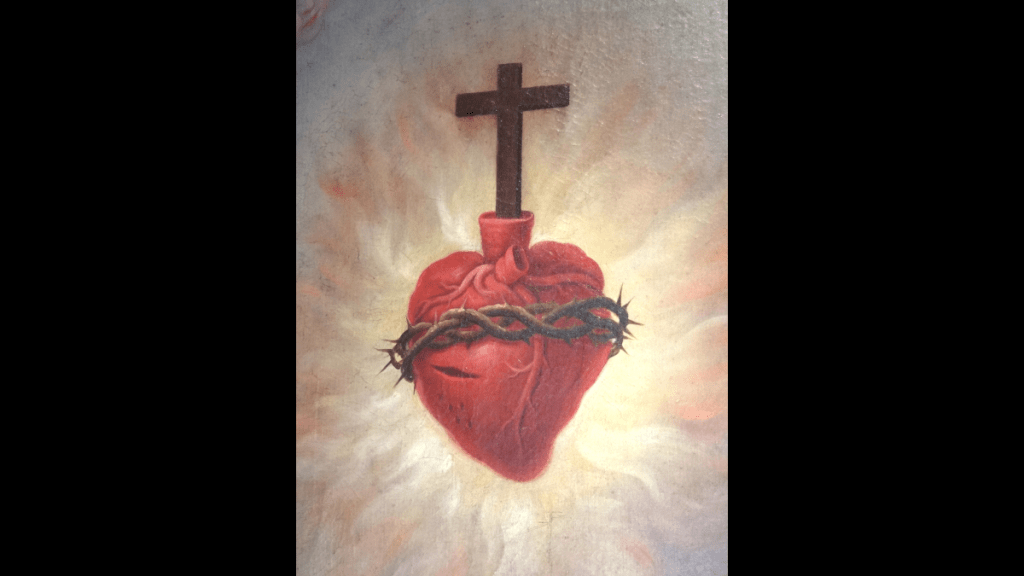

In the Directory on Popular Piety and the Liturgy, devotion to the Sacred Heart is described this way, “Understood in the light of the Scriptures, the term ‘Sacred Heart of Jesus’ denotes the entire mystery of Christ, the totality of his being, and his person considered in its most intimate essential: Son of God, uncreated wisdom; infinite charity, principal of the salvation and sanctification of mankind. The ‘Sacred Heart’ is Christ, the Word Incarnate, Savior, intrinsically containing, in the Spirit, an infinite divine-human love for the Father and for his brothers” (DPPL. n.166). While devotion to the Sacred Heart of Jesus became theologically mature in the 18th century, devotion to the humanity of Jesus gave rise to a practice known as devotion to the Wound in the Side. Two treatises of Saint Bonaventure attests to the practice – Vitis mystica and De lingo vitae.
Whenever you identify the whole of given reality by one of its parts, you know that that one aspect or dimension of the whole is critical to its understanding. The heart is thus a synecdoche wherein a part of something is used to refer to the whole. For example, “You have my whole heart” — using “heart” to represent your whole person: heart, mind, body, and soul. Thus, while Christ’s whole body was perforated with those Five Wounds on the cross, yet, the Heart of Christ has become the one part of His whole Body that is critical to its proper understanding. To identify Jesus with His Sacred Heart, then, is to focus on the most critical dimension of Christian existence.
Saint John Eudes propagated devotion to the heart of the Savior. He is probably best known for the central theme of his writings: Jesus as the source of holiness; Mary as the model of the Christian life. His devotion to the Sacred Heart and to the Immaculate Heart led Pope Pius XI to declare John Eudes the father of the liturgical cult of the Hearts of Jesus and Mary.
However, it was from Paray-le-Monial that this devotion became far-reaching reached its height. In 1673, the future Saint Margaret Mary experienced Christ’s presence in a way she never had before while praying. She heard Jesus tell her that he wanted to show his love for people by encouraging a special devotion to his Sacred Heart. Later, on June 16, 1675, Christ told Sister Margaret Mary to promote a feast that honored his Sacred Heart. He also gave her 12 promises made to all who venerated and promoted the devotion of the Sacred Heart. Christ revealed ways to venerate his Sacred Heart and explained the immense love he has for humanity, appearing with his heart visible outside his chest, on fire, and surrounded by a crown of thorns. Christ told Sister Margaret Mary: “My Sacred Heart is so intense in its love for men, and for you in particular, that not being able to contain within it the flames of its ardent charity, they must be transmitted through all means.” These visions continued for 18 months.
One carved depiction of the Sacred Heart forms the key-stone of an arch at the Grande Chartreuse, located in France, just north of the city of Grenoble, in part of the old cloister which was built after the fire of 1473. A cross is seen rising out of a tomb, with the three nails, the rod and the sponge on a reed on the right, and on the left three dice, pincers and hammer, and a scourge. Above are the thirty pieces of silver, and the crown of thorns is hanging on the right arm of the cross. These arms of the Passion are common enough: what is exceptional in the shield of the Grande Chartreuse is the heart in the center of the cross, with a large wound entirely penetrated by a lance. This has been reckoned as the oldest known carving of the Sacred Heart of Jesus.
 Nature and dignity