
At first, public Exposition of the Blessed Sacrament was permitted only on Holy Thursday and Corpus Christi, but later, at other times, it became a popular expression of shared faith in the Eucharistic Lord. In a decree known by the Latin title Eucharisticum mysterium, the first and current edition of Holy Communion and Worship of the Eucharistic Mystery Outside Mass (HCWEM) was published on 25 May 1967. Recently, on March 7, 2023, the Dicastery for Divine Worship and the Discipline of the Sacraments confirmed a new English language edition of HCWEM that is meant to be put into use on September 14, 2024. In detailing the relationship between Exposition of the Blessed Sacrament and the Mass, the earlier decree states that adoration of the Blessed Sacrament is meant to prolong the Mass: “[T]he act of adoration outside Mass prolongs and intensifies all that takes place during the liturgical celebration itself.”
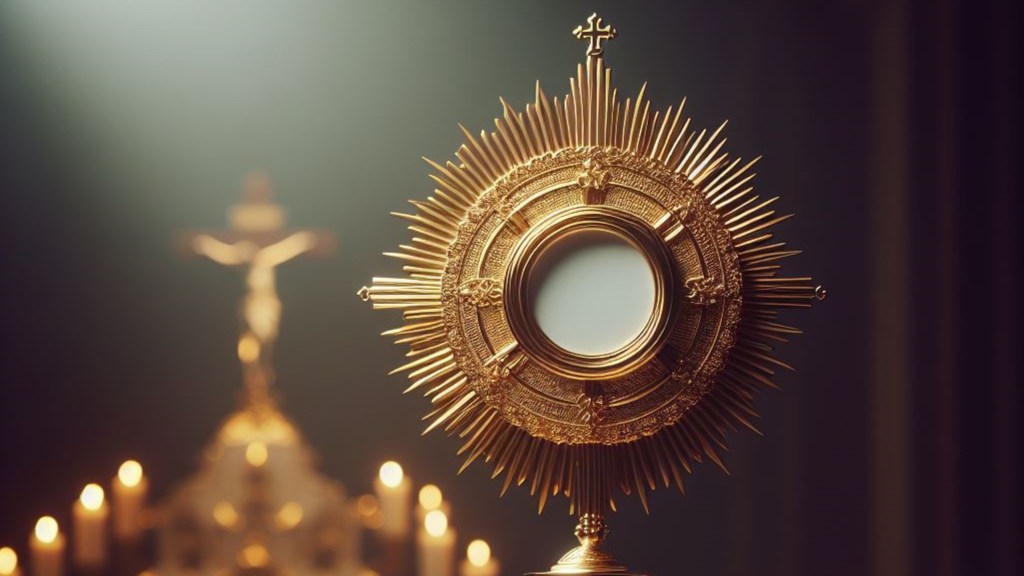
Eucharistic exposition is that rite by which the Blessed Sacrament is displayed outside of the tabernacle either in a monstrance or ciborium for public veneration by the faithful. Exposition should not obscure “the principal desire of Christ in instituting the Eucharist, namely, to be with us as food, medicine, and comfort.” Whenever Exposition and Adoration of the Blessed Sacrament takes place after Mass, it highlights its proper place as an outgrowth of the worship of God in the Mass. Christ gives us his Most Precious Body and Blood primarily as food. Exposition and adoration, following participation in the Mass and the proper reception of Holy Communion, therefore allows for a prolongation of Communion by resting in God’s presence, in communion with Him, pondering that august mystery of Christ’s Real Presence.
Receiving the Incarnate Lord in the Eucharist is both a physical and spiritual process: “eating [the Eucharist] … involves the whole person. ‘Eating’ means worshipping it. Eating it means letting it come into me, so that my ‘I’ is transformed and opens up into the great ‘we’, so that we become ‘one’ in him. Thus adoration is not opposed to Communion, nor is it merely added to it. No, Communion only reaches its true depths when it is supported and surrounded by adoration” (Joseph Ratzinger, The Spirit of the Liturgy).

