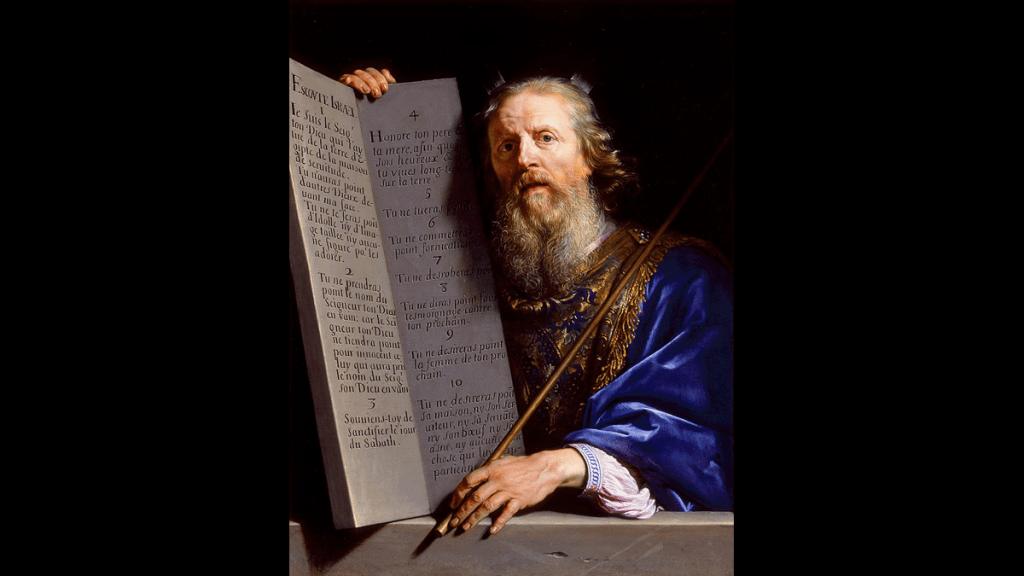

The Pentateuch, or the first five books of the Bible, declares a large number of laws given by God, through Moses, to the Israelites during the forty years they wandered in the wilderness and as they prepared to enter the promised land of Canaan. Jews have traditionally numbered these Mitzvot at 613, of which 248 are dos and 365 are don’ts. Ten of these have special significance, as they were twice written by the finger of God onto stone tablets prepared for God by Moses. Also known as the Decalogue, it is a name that literally means “ten words” (Gk. δεκάλογος). In Christian circles, the more common name is the Ten Commandments.
In Hebrew, they are not referred to as commandments but as the Ten Words (Heb. eseret ha-devarim). Mitzvot’s singular version mitzvah refers to a commandment from God that is meant to performed as a religious duty. These ten words are given to us twice: once in Exodus 20 (Ex 20:1-17) and again in Deuteronomy 5 (Dt 5:6-21). Moreover, these Words are also incorporated into the Ritual Decalogue (Ex 34:11–26) and, further on, the Hebrew title is made explicit, “So Moses was there with the Lord for forty days and forty nights, without eating any food or drinking any water, and he wrote on the tablets the words of the covenant, the ten words” (Ex 34:28). Also, these Words are scattered in Leviticus 19: 3-4, 11-13, 15-16, 30, 32, where a partial set of the Ten Words can be found. According to the Catechism of the Catholic Church, “Beginning with the Old Testament, the sacred books refer to the ‘ten words,’ but it is in the New Covenant in Jesus Christ that their full meaning will be revealed…” (CCC, n. 2057).
You would look in vain for any of the aforementioned biblical references as containing the various popular renderings of the Ten Commandments. The Greek, Anglican, and Reformed traditions usually follow the form that appears in the first Exodus version from chapter 20. On the other hand, Catholics and Lutherans follow what could be classified as their its catholic version that bases itself upon the mitzvot found in Deuteronomy. This text was likely written in the seventh century BC, around 300 years later than the Exodus text that forms the basis for the Protestant version of the Ten Commandments. Scholars have identified both Exodus versions as having probably been written in the tenth century BC.
Judaism, too, has a listing of the Ten Words, but while the number is the same, the ordering of the commandments varies in all three popular versions. Unlike Catholicism and Protestantism, Judaism considers “I am the L-rd, your G-d” to be the first commandment. Catholicism, unlike Judaism and Protestantism, considers coveting property to be separate from coveting a spouse. Protestantism, unlike Judaism and Catholicism, considers the prohibition against idolatry to be separate from the prohibition against worshipping other gods. The prohibition against graven images (Dt 5:8) is not mentioned in the catholic version. As a result, Deuteronomy 5:21 is divided into two commandments, separating the coveting of a wife from the coveting of farm animals. No two religious denominations agree on a single list, though all agree on the number ten.
The Ten Words were originally part of a Jewish document and that is why they too have their own way of structuring it. Jews begin the Ten Words with this statement, “I am the Lord your God who brought you out of the land of Egypt, out of the house of bondage.” The medieval Jewish philosopher Maimonides argued this was the greatest Commandment of all, even though it does not command anyone to do anything at all because it forms the basis for monotheism and for all that follows from it. The two Christian versions, however, regard this as a preamble instead of an actual commandment and, so, begin their lists with the statement, “You shall have no other gods before Me.” Always ten, but variable content and numbering among the three versions.

