
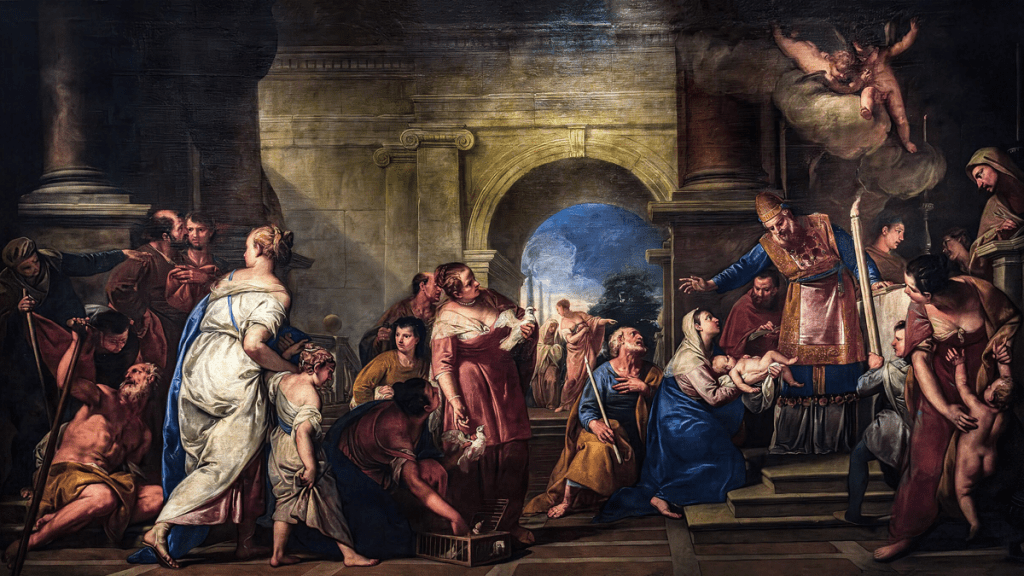

Taking place on February 2, the Presentation of the Lord in the Temple occurs on the fortieth day after Christmas. According to the Book of Leviticus (Lev 12:1-8), a woman was regarded as ritually unclean for forty days after the birth of a male child and for eighty days after the birth of a female. The mother had to bring the priest a lamb and a young pigeon or turtledove as a sin offering or two turtledoves if she were poor. Then, because a first-born son was seen as belonging to the Lord (Ex 13:2), as such, he had to be brought before the God of Israel and redeemed with a monetary offering (Num 18:16) of five shekels.
In accord with these regulations, then, Mary and Joseph brought Jesus to the temple “to present him to the Lord.” The focus in their doing so is on Jesus’ consecration to God. The verb “to present” means “to place beside”, etcetera . Yet, the Greek form of that word (Gk. παραστῆσαι=to place beside, to present, stand by, appear) or paristémi also means to offer, which evokes Jesus being presented as the priest to God who will subsequently offer Himself as the perfect sacrifice to free the world from the slavery of sin, seal the new and eternal covenant with His blood, and open the gates to the true promised land of heaven. In addition, on this feast day, Mary offered the sacrifice that constituted her purification and, at the same time, ransomed her firstborn Son.
Simeon, a just and pious man, who awaited the Messiah and looked for the consolation of Israel, was inspired to come to the temple. The English word translated as “consolation”, in Greek, is paraklesis that can also be translated as to comfort or to exhort. The more literal translation of paraklesis means “calling to one’s side” (para = beside, kaleo = to call). A closely related word is parakletos (Gk. Παράκλητος), which is rendered in English as “one who comes alongside” or “advocate.” Parakletos has the connotation of legal assistance, as the defense counsel or advocate for the accused. In a sense, the parakletos is both a comfort to the accused as well as an intercessor on the accused’s behalf. In Johannine literature, Paraclete refers to the Holy Spirit as Helper, Guide or Advocate (Lat. Advocatus).
Simeon held the Child Jesus in his arms and blessed God, saying, “Now, Master, you may let your servant go in peace, according to your word, for my eyes have seen your salvation, which you prepared in the sight of all the peoples: A light for revelation to the Gentiles, and glory for your people Israel” (Lk 2:29-32). Simeon, thereby, announced that the Messiah had come not just to Israel but the Gentiles and not just for the righteous, but to the sinner. He then blessed the Holy Family, and said in turn to Mary: “Behold, this child is destined for the fall and rise of many in Israel, and to be a sign that will be contradicted— and you yourself a sword will pierce— so that the thoughts of many hearts may be revealed” (Lk 2:34-35).
Despite its myriad elements, the Presentation of the Lord, in its essence, is a proclamation of Christ as Messiah and Priest, Lord and Savior. He is the light who came into this world to dispel sin and its darkness. For this reason, traditionally at least since the seventh century, candles have been blessed at Mass on this day that will be used throughout the year, hence coining the term “Candlemas.”

