
Most Holy Trinity
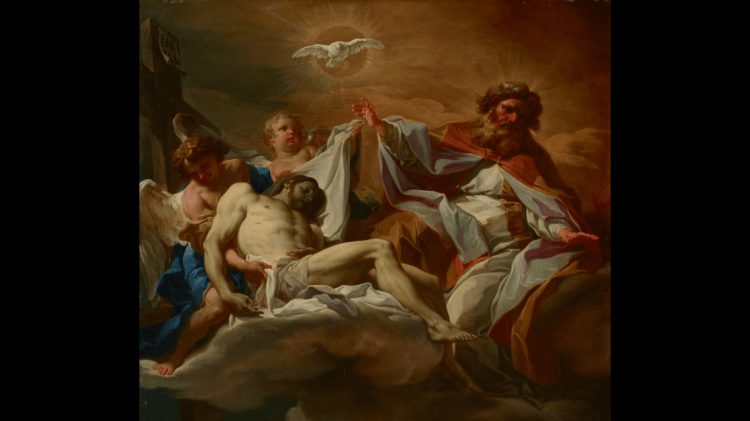
Trinity Sunday Gospel—John 16:12-15
In an apparent contradiction to what Jesus had said earlier that He had made known to the disciples all that He had heard from the Father (Jn 15:15), at the outset of this weekend’s Gospel Jesus tells them, “I have much more to tell you, but you cannot bear it now.” Throughout the Fourth Gospel, it often has been revealed that Jesus is the full and complete revelation of God the Father – to see Jesus is to see God. Thus, the aforementioned contradiction does not imply new content, but that what has already been fully revealed will find the Spirit doing what is necessary to deepen understanding. At that point, in salvation history, it would be impossible for the disciples to bear (Gk. βαστάζειν) the total message and its sacred content until the Spirit of truth (Gk. pneuma tes aletheia) comes. This divine gift will take place at a future time.
The series of verbal expressions describe the Spirit’s actions – Guide, Counselor, Comforter, Paraclete and so forth. The current experience of the disciples, herein depicted with Jesus at the Last Supper, along with their future experience with the Spirit is that such a future context will be marked by Jesus’ departure from the world. In the post-Ascension period, after Jesus’ return to God, the Spirit facilitates a fuller understanding of Jesus’ revelation without any change to its content. Just as Jesus did, the Spirit reveals the Father.
In John 16:13, it is clearly stated that enriching and deepening of what has been revealed will happen “when he comes, the Spirit of truth, he will guide you to all truth. He will not speak on his own, but he will speak what he hears, and will declare to you the things that are coming.” So, the Spirit will declare to the disciples the things that are coming, though that declaration is not meant to be a reference to new predictions about what the future would be like, but the deeper or more profound interpretation of what had already occurred or been said.
The Greek verb used for the Spirit’s act of guiding or hodégeó (Gk. ὁδηγέω) combines the noun hodos (Gk. ὁδός) coupled with the verb ágō (Gk. ἄγω) meaning, in English, to lead, to guide, to direct or to lead through to something. By guiding us “into all the truth,” where “truth” is the revelation of God found in and through Jesus, the Spirit will “bring the way.” Though the Spirit speaks only “whatever he hears”, which is parallel with Jesus’ method of revealing only what He hears from God. Even though Jesus is no longer physically present as God’s Revealer, even now, the believer can trust that Jesus and the Spirit share the same source of revelation: God the Father.
The Fourth Gospel’s particular understanding of the Spirit recognizes two realities about how the Christian faith relates to its past and future. The first is that the revelation that took place in and through Jesus is fundamental for Christian identity. The second is that, as fundamental and eternal as Jesus’ revelation is for Christians, the world will keep turning from the time that Christ’s revelation first made itself known. The early Church in John’s day, even today, and for always, finds herself trying to understand and live her faith in the midst of social, cultural, and global circumstances that change rapidly.
It might have been tempting for John — whose theology gave central importance to the Incarnation (Jn 1:14) — to devalue any new understanding of the Christian message that emerged when Jesus was no longer visible in the flesh to deliver it Himself. Instead, John places firm confidence in the Spirit as continuing the ongoing presence and revelation of Jesus within the Christian community after Jesus’ return to God. For John, then, the Church does not need to ever fear learning and practicing her faith in Jesus in the midst of a changing world marked by Jesus’ physical absence. This is because the Spirit “will declare to you the things that are to come” (Jn 16:13). In other words, the Spirit makes possible a “deep understanding of what Jesus means for one’s own time” without betraying the core truth of Jesus’ original revelation.
Excerpted from http://www.workingpreacher.org. Gilberto A. Ruiz. “Commentary on John 16:12-15.” 22 May 2016
 Nature and dignity