
Pentecost Sunday
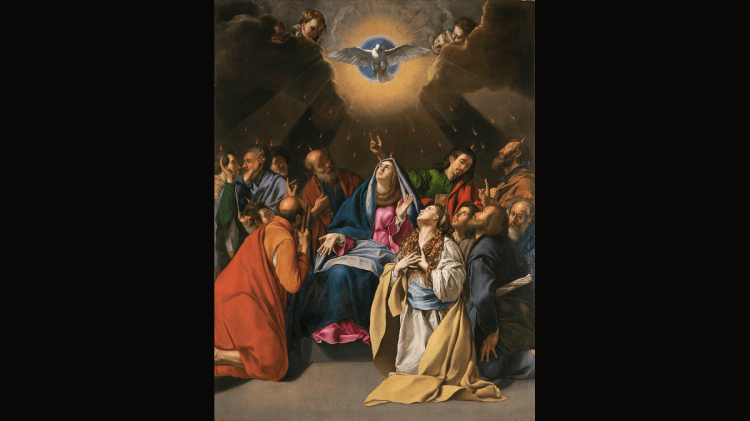
Golden Sequence – Veni, Sancte Spiritus
The liturgical revisions of the Second Vatican Council sought to reaffirm the close connection between the gift of the Spirit and the Lord’s resurrection and ascension. The Spirit and the accompanying seven-fold gifts are essential to understanding and living out the Paschal Mystery, which is the central mystery of salvation history, encompassing Jesus’ Passion, Death, Resurrection, and Ascension. The Spirit empowers Christians to participate in this mystery, offering strength, guidance, and the ability to live a life of faith, love, and service.
Though once overly used, a feature of prominent feasts is the Sequence that once numbered over 5000, which is now only used on four occasions: Easter, Pentecost, Corpus Christi, and in honor of Our Lady of Sorrows. The Dies Irae (Eng. Day of Wrath) sequence was removed from the Requiem Mass and, then, resituated in the Liturgy of the Hours as an Advent hymn.
The sequence for Pentecost is called Veni, Sancte Spiritus or the Golden Sequence. Its authorship is the subject of scholarly debate – some believe it was composed by Stephen Cardinal Langton (1128), who was the archbishop of Canterbury, whereas other liturgists ascribe it to Pope Innocent III (1216). In its original language, this sequence is considered to be one of the masterpieces of sacred Latin poetry. Regardless of its author, the Golden Sequence was obviously the work of someone who had not only experienced great sorrow, but also found immense consolation within those trying times. This hymn is not only an invocation; in fact, it is a plea asking for the Spirit to dwell within the hearts of the faithful with the radiant fruit that only a Spirit-filled life can produce.
Another title for the Spirit, after that of Love, is Gift. True charity or love is the first gift and, as the Divine Giver, the Spirit brings life to souls. As the Spirit of Christ, the Spirit-created yoke is sweet and the burden it entails is light (cf. Mt 11:30). As the Spirit of Truth, at the coming of the Paraclete, all that the Lord taught the Spirit will not only be preserved but also deepened. As Advocate (Gk. παράκλητος), called alongside, the Spirit is understood as Protector and Counselor. The Spirit’s presence softens hardened souls and provides the dew for new growth and rebirth. The Third Person of the Trinity balances virtuous behavior by engendering the virtue of prudence, vacillating between the extremes of too much or too little.
Finally, those seven-fold gifts (Lat. Sacrum Septenarium) of the Spirit bloom under the divine rays of charity and truth. Virtue, like a healthy plant, cannot but grow under the rays of the Spirit, before finally introducing the soul, thus perfected, into Trinity’s bosom.
 Nature and dignity