
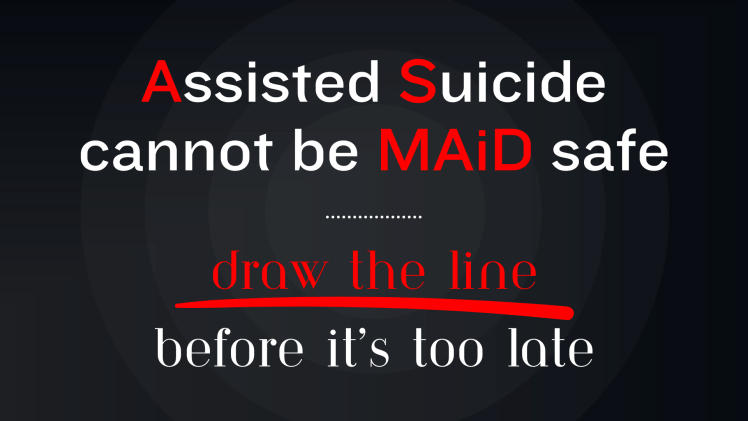
For the 194th General Court of Commonwealth of Massachusetts, i.e., the 2025-2026 legislative session, my testimony against the End-of-Life Options Act focused on the core provisions of the bill that are compelling people to think favorably about the practice of assisted suicide. I describe ways those provisions have been, are in the process of, or would eventually be removed. The law is not what people think it is – not voters, not poll-takers, not even some of the legislators. Those who assure us of the “strong safeguards” in the bill are just echoing the familiar false mantra of “legal, safe, and rare”. Assisted suicide cannot be MAiD safe.
I point out that the two reasons supporters say we need this bill, heard in every favorable testimony, are suffering and autonomy. The testimonies, of course, all relate to people at the very end of their lives experiencing physical suffering. Why should they have to suffer? Why can’t they choose to hasten their deaths and doctors choose to help them? You don’t have to choose it if you don’t want to. Suffering and autonomy are the hinges on which the door to assisted suicide are being swung opened.
Poll questions are written to give the impression that choosing to hasten death if suffering at the very end of life is what the bill addresses. If the bill was truly restricted to that, why don’t the “safeguards” guarantee it? Why doesn’t the bill prevent the safeguards from every being modified or removed? Why does the bill require secrecy and deceit to protect the exceedingly few doctors that participate in it?
Suffering and autonomy will be the reasons used again and again to remove the “safeguards” by declaring them barriers to those who want to end their lives. This is the fundamental mindset of assisted suicide advocates: I am not satisfied with my “health” in some way, my life is no longer “worth” living, why should I “suffer”, and I want to control the timing and manner of my own death. Where legal, people do not choose assisted suicide for physical suffering but because life is no longer pleasurable and to avoid being a burden to others – whether or not others think them a burden.
Let’s ask this poll question: “Do you think people with any kind of medical diagnosis that is experiencing any kind of suffering, including dissatisfaction, should be able to access MAiD?” Isn’t that what MAiD is quickly becoming in the Netherlands, Belgium, and Canada? Isn’t that where arguments based on suffering and autonomy lead? Even using the term “MAiD” rather than “physician assisted suicide” prepares for eventual expansion into euthanasia. The only requirement consistent throughout all the places where MAiD is legal is a medical diagnosis. That is the rope wrapped around the medical system compelling it to legitimize and provide it.
From that foundation comes my testimony. I focus on the three key “safeguards” of terminal illness, self-administration, and competence to point out how tenuous each of them are and the arguments being used to remove them once MAiD is legalized. Here are a series of taglines that summaries the problem with legalizing assisted suicide. Choose one or more and make the point with your state legislator.
- Legalization = expansion
- MAiD is NOT what you think it is.
- Don’t open the door to assisted suicide.
- Assisted suicide cannot be MAiD safe – draw the line before it’s too late.
Here is my full testimony.
 Nature and dignity