
5th Week of Easter

Psalm 115 or Psalm 113
This week, on Monday, the chosen psalm is Ps 115 (113) and the response is “Not to us, O Lord, but to your name give the glory.” One numbering system for the psalms is that used by the Hebrew Masoretic text. This is the version used by most modern Bible translations. Another is that used by the Greek version of the Old Testament or the Septuagint (LXX). This version was inherited by the Latin Vulgate and thus by the Douay-Rheims. The difference in numbering between the two varies, for example, when the Hebrew psalms 9 and 10 are joined as the Greek psalm 9. Such a discrepancy causes the Greek numbers to be one less than the Hebrew numbers for most of the book, the Hebrew numbering sometimes combines (splices, joins) a psalm that is reckoned as two psalms in the Greek numbering and vice versa. The first time the numbering varies is when the Hebrew psalms 9 and 10 are joined as the Greek psalm 9. Thus, there is the reason why the well-known Hebrew 23rd psalm gets reckoned as the Greek 22nd psalm. The same thing happens when the Hebrew psalms 114 and 115 are joined as the Greek psalm 113.
On Monday of the Fifth Week of Easter, psalm 115 (113) is the responsorial psalm. In the King James Version, Psalm 115 begins with “Not unto us, O Lord, but unto thy name give glory.” However, in the Greek Septuagint (LXX) or the Latin Vulgate, the same material constitutes the second part of Psalm 113 designated as verses 9-26 along with verses 1-8 being the equivalent of psalm 114 in their Hebrew numbering. This latter section, in Latin, is known as Non Nobis—a prayer of thanksgiving and an expression of humility.
Historical & Contemporary Impact
Henry V of England was a remarkable king who might have become emperor of Europe had he not died of a fever in France at the age of thirty-five. He had been wild and frolicsome in his younger days, a lifestyle effectively dramatized by Shakespeare in Henry IV, Parts 1 and 2, where is referred to as “King Hal”. But he changed when he assumed the throne, becoming “honest, grave and modest,” as one contemporary historian has recorded.
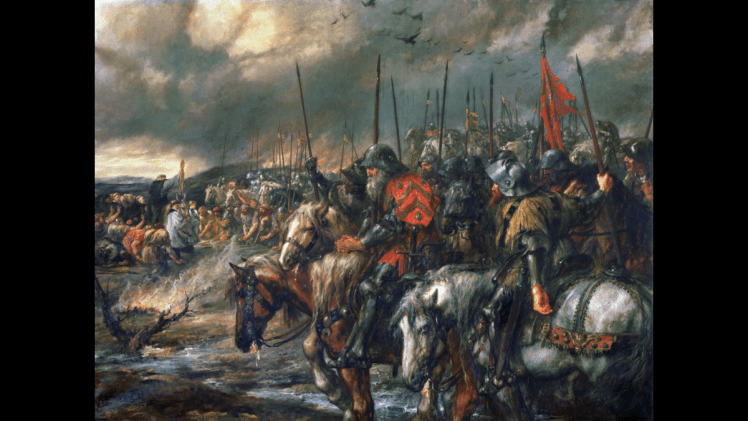
Henry dedicated himself to uniting Christendom against the advancing Turks, conquering France, the hereditary enemy of England, along the way. So on August 11, 1415, he left England with 1,300 ships and 11,000 men, landed at Harfleur near the mouth of the Seine and after capturing that city advanced toward Calais. The French met him at Agincourt on October 25, St. Crispin’s Day. The opposing French army relied on its mounted chivalry, but its knights were no match for the English bowmen. Their horses were mired in mud caused by the heavy fall rains, and they were unable to advance against the sharp stakes the English had planted at an angle in the ground to protect their bowmen. When the horses turned back, they pressed against their own army, and the English fell upon the chaotic mass of retreating soldiers with maces, hatchets and swords. King Hal fought in the thick of the battle, too excited for fear, and the triumph was overwhelming. French historians put the English losses at 1,600 men against the French losses of 10,000.
Several years before this, when he had been called to share in the government by his father, Henry IV, he had been given Psalm 115:1 as a guide. Now as Henry V, the king commanded the victorious English armies to kneel in the mud of Agincourt and sing this hymn together: Non nobis, Domine, sed tibi sit gloria (“Not to us, O Lord, but to thyself be glory”). The Psalm reads, “Not to us, O Lord, not to us but to your name be the glory, because of your love and faithfulness.”
In his play Henry V (Act 4, Sc. 8), Shakespeare has the king saying, “Do we all holy rites; Let there be sung ‘Non nobis’ and ‘Te Deum.'” Non nobis is the incipit and conventional title of a short Latin Christian hymn used as a prayer of thanksgiving and expression of humility. The Te Deum (Eng. Thee, God, we praise) is another Latin hymn directed to God the Father and Christ the Son of God. The Te Deum is composed of traditional statements of belief, yet, unlike most hymns, it is in prose. It is a hymn of adoration and thanksgiving, calling upon all creation to praise and worship God.
In the last century, the composer Patrick Doyle, for Kenneth Branagh’s 1989 production of Shakespeare’s Henry V , created a moving rendition of this event coming after the Battle of Agincourt, when it finally becomes clear that the vastly outnumbered English army had in fact routed the French. It is a penetrating and lyrical theme of both sadness and hope to accompany the movie’s long tracking shot as King Henry marches across the field of battle, carrying one of his English casualties on his back. Doyle’s soaring sacred piece rises above all of this, building and building from the soloist onward as more and more of the musical forces join in. The result is sublimely effective — Non nobis domine – Not to us, O Lord, not to us; but to your name give the glory. Latin Vulgate, “Nōn nōbīs, Domine, nōn nōbīs, sed nōminī tuō dā glōriam” (Ps 113:9 LV).
Excerpted from www.thinkandactbiblically.org. James Montgomery Boice. “The Victors’ Psalm at Agincourt.” 4 November 2019
 Nature and dignity