Holy Week
Elements of the Sacred Triduum
Holy Week is the most solemn and glorious week in Christianity, the pinnacle of the liturgical year. It’s more sacred than Christmas! This is because Holy Week commemorates the final week of Our Lord’s life, the very purpose for which Christmas occurred. Holy Week begins with Palm Sunday (when Jesus made his final entrance into Jerusalem) and culminates with Easter Sunday. As Holy Week progresses to its final days, the ongoing solemnity heightens.
THE SACRED TRIDUUM
Sundown on Holy Thursday to sundown on Easter Sunday is considered the most solemn part of the liturgical year. This three-day period is referred to as the Easter Triduum, also known as the Sacred or Paschal Triduum. The word “triduum” comes from the Latin word of the same name, which comes from tris (“three”) + dies (“day”). Basically, the Sacred Triduum is one great festival recounting the last three days of Jesus’ life on earth, the events of his Passion and Resurrection, when the Lamb of God laid down His life in atonement for sins.
According to the US Conference of Catholic Bishops, these three days are, in fact, one continuous act of worship, “Though chronologically three days, they are liturgically one day unfolding for us the unity of Christ’s Paschal Mystery.” It is known as the Paschal Mystery because it is the ultimate fulfillment of the ancient Jewish Passover (or Pesach), which itself was a recollection of how God brought the Chosen People out of their slavery in Egypt. The spotless lamb was slaughtered at the Passover meal and consumed—on that same night the destroying angel “passed over” the homes marked with the blood of the Passover Lamb and those covered by the Blood of the Lamb were saved. This was the Old Testament prefiguring of Jesus’ work at the Last Supper—where He inserted Himself as the Paschal Lamb and, on Calvary, where the sacrifice was offered to save the world from slavery to sin.
With the Holy Eucharist, by receiving the Body of Christ, the faithful consume the victim that died for their sins. The Paschal Mystery is, therefore, God’s plan of redemption for the fallen human race through the passion, death, and resurrection of the God-man Jesus Christ. It is one marvelous event stretched out over three days.
HOLY THURSDAY
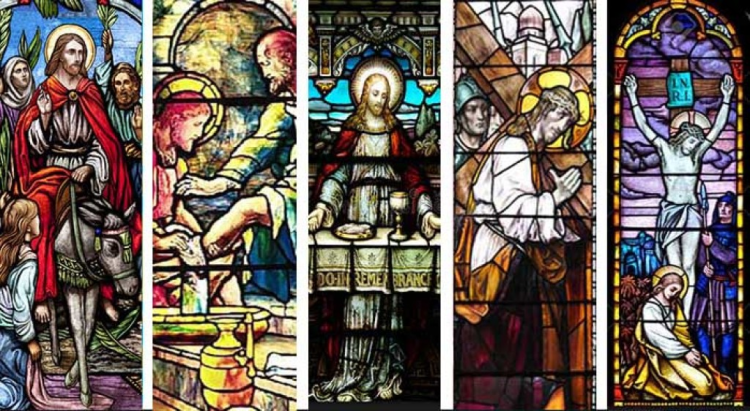
The evening Mass on Holy Thursday is referred to as The Mass of the Lord’s Supper. This is where the Church re-lives the institution of the Eucharist and the Holy Sacrifice of the Mass that took place at the Last Supper and the institution of the priesthood, which took place the evening before Jesus was crucified. After the homily there is an optional rite of the washing of the feet, where the priest washes the feet of others to signify the priestly role of servant—just as Jesus did with His own disciples. Extra hosts are consecrated at this Mass to be used on Good Friday when no Mass can be celebrated.
The Mass of the Lord’s Supper on Holy Thursday concludes with a procession of the Blessed Sacrament to the altar of repose, a place where the consecrated Hosts are kept, away from the main altar where Mass is normally celebrated. Many parishes will create space for people to stay and pray with the reposed Eucharist at this altar of repose later into the night, remembering Jesus’ request in the Garden of Gethsemane for someone to “watch and pray” with Him.
GOOD FRIDAY
Good Friday is one of the two days of mandatory fasting as well as abstaining from eating meat. This is the day of the crucifixion, the day Jesus died for the sins of the world. The altar looks very different on Good Friday: it is plain and bare. There are no consecrated Hosts in the tabernacle behind the altar in the chapel. It was carried away on Holy Thursday night to the “altar of repose” to signify Jesus’ death. The sanctuary candle, above the tabernacle, has been extinguished, and the tabernacle doors are left open to show that it is empty. Jesus is gone. This is quite dramatic, reminding us that Good Friday is a solemn day of mourning and prayer.
The ceremony on Good Friday is not a Mass—once, called the Liturgy of the Presanctified, before the Second Vatican Council, now it is akin to a communion service using the consecrated hosts from Holy Thursday. Good Friday is the only day of the year during which no Masses are offered. These Good Friday services often take place at the three o’clock hour, the hour when Jesus breathed His last on the Cross. Often the priest will begin the service by either kneeling or prostrating himself in front of the altar. Veneration of the Cross usually takes place at this liturgy, in which the priest and the faithful kneel before a cross and render the wood of the Cross some sign of adoration: whether by kissing, touching, or through a profound bow before the wood of the Cross.
HOLY SATURDAY
There is no daytime Mass on Holy Saturday, whether in the morning or early afternoon. It is still a day of fasting and sorrow before the Easter Vigil begins that evening. The whole Church recalls, with Mary and the disciples, that Jesus died and was separated from them for the first time as He laid in the tomb. The faithful often continue their Good Friday fast through Holy Saturday.
In the Apostles Creed we pray “He descended into hell” (translated Hades, that is, the temporary abode of the dead—not the eternal lake of fire) which describes what Jesus did in the time between His burial and Resurrection. Jesus descended to the realm of the dead on Holy Saturday to save the righteous souls—the Old Testament patriarchs, for example—who died before his crucifixion. The Catechism of the Catholic Church calls Jesus’ descent into the realm of the dead “the last phase of Jesus’ messianic mission” (CCC, n. 634), during which he “opened heaven’s gates for the just who had gone before him” (CCC, n. 637). Before Holy Saturday, there were no souls enjoying the beatific vision of God in heaven! Christ’s work on Holy Saturday is also known as the “Harrowing of Hell.”
HOLY SATURDAY—THE EASTER VIGIL
A vigil Mass is held after nightfall on Holy Saturday or before dawn on Easter Sunday, in celebration of the resurrection of Jesus. This is called the Easter Vigil: the most glorious, beautiful, and dramatic liturgy of the Church. The vigil is divided into four parts and can last several hours: 1) the Service of Light, 2) the Liturgy of the Word, 3) the Liturgy of Baptism, and 4) the Liturgy of the Eucharist. This is also the Mass in which many OCIA (formerly RCIA) catechumens are brought into full communion with the Catholic Church. Although celebrated Holy Saturday evening, it is the dramatic Easter vigil liturgy that marks the beginning of Easter. As the gathered faithful, the vigil’s participants are awaiting the Master’s return with their lamps full and burning, so that when Christ comes again, He will find them awake and seated around the altar, commemorating His sacrifice on Calvary.
EASTER SUNDAY
Having prepared for forty days by Lent’s penitential practices, Easter is a day of great spiritual significance and a fitting occasion for recalling the meaning of baptism, to examine life in light of the baptismal promises and, by doing so, to deepen the relationship with God. The renewal of baptismal promises is the goal of Lent. All Lenten activity should move the faithful toward this goal. For example, when you go to Confession during Lent, it has added significance. Our Lenten Confessions should prepare the penitent to reject Satan, all his works, and all his empty promises and to make a deep act of faith in the Father, Son, and Spirit.
According to the Catechism, “The Resurrection above all constitutes the confirmation of all Christ’s works and teachings. All truths, even those most inaccessible to human reason, find their justification if Christ by his Resurrection has given the definitive proof of his divine authority, which he promised. (CCC n. 651). Baptism corresponds to what Christ suffered in the Paschal Mystery — death, burial, and resurrection. Saint Paul described baptism this way, “You were buried with him in baptism, in which [i.e., baptism] you were also raised with him through faith in the power of God, who raised Him from the dead” (Col 2:12). Christ is risen, he is truly risen! Alleluia, alleluia, alleluia!
 Nature and dignity