
Laetare Sunday
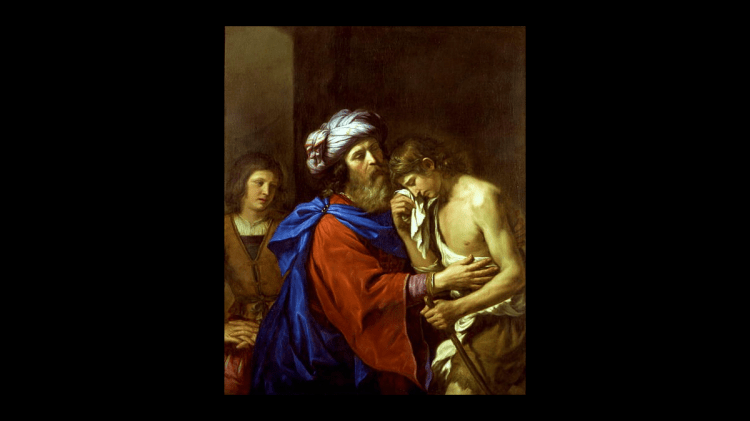
The Real Prodigal — Son or Father?
Charles Dickens famously described the parable of the Prodigal Son as “the finest short story ever written.” Arguably, this parable is the most well-known of all the parables that Jesus recounted; so much so, that elements of the incident have even entered the public consciousness. However, because that has occurred, by being overly-familiar and superficially understood, the parable is poorly understood. Even the adjective “prodigal” needs to be examine in order to gain a deeper knowledge of its implications.
The word is derived from the Latin word prōdigālis meaning “lavish” or “wasteful”. Easily overlooked is the fact that the father acquiesces to the boy’s petulant request for his share of the inheritance rather than rebuking the boy for his audacity. At any point in the exchange, the father could have regained control over his son’s actions and prevented him from having to sell off the family estate. No such action appeared to be taken. Instead, the father had to divest himself of his property in order to divide it between the two brothers. Thus, the father gives all that he had. Leaving home, “to set off to a distant country,” the son squanders his inheritance, lives a reckless life, and eventually he is forced to return home humbled and seeking forgiveness.
The late German theologian and lexicographer Walter Bauer (1877-1960) describes what the son did as “a madness that knows no bounds.” The parable’s principal character is the father, the respectable owner of a wealthy estate with servants and fattened calves to spare. The prodigality of the father is usually skipped over; yet, instead of the profligate or prodigal son, it is the father who is the most foolish or extravagant in his actions. Moreover, the extravagance is not the inheritance that the man divided at the younger son’s insistence, nor is that estate-owner’s social status that made him foolish. What is truly extravagant or reckless is that father’s love for his wayward son.
The parable begins with, “A man had two sons” (Lk 15:11), with the normal word for ‘son,’ meaning two heirs. Then immediately the narrator says, “…the younger of them.” A father, two sons, one of whom is younger, indicate a hierarchy in the male-dominated world of the first century. The first half of this parable deals with the younger son, who flees his family and squanders his inheritance, but the father welcomes him back. The second part of the parable turns to the elder son, who challenges and rejects the father’s acceptance of the younger son, snidely characterizing the wayward son not as a brother but as “this son of yours,” and foolishly welcoming him back into the family.
The older son basically claims that the father loves the boy more than he does the elder son. In a shame/honor culture like the first century Mediterranean, the elder son’s challenge and rejection of his father is profound and demands a response. Otherwise, the father would be shamed and lose his honor. Then, at the conclusion, the father addresses his older, disgruntled son saying, “My son, you are here with me always; everything I have is yours…” This is why the father is the true “prodigal.” He is heedless, wasteful, and excessive in his gracious joy. His is a madness that knows no bounds. This parable is a portrayal of the prodigal love of God.
Excerpted from http://www.levaire.com. Guest Contributor. “Like a Madness That Knows No Bounds: The Parable of the Prodigal Father.” 21 March 2023. Used with permission from For People Like Us: God’s Search for the Lost of Luke 15 by Luuk van de Weghe.
 Nature and dignity