
Second Sunday of Lent
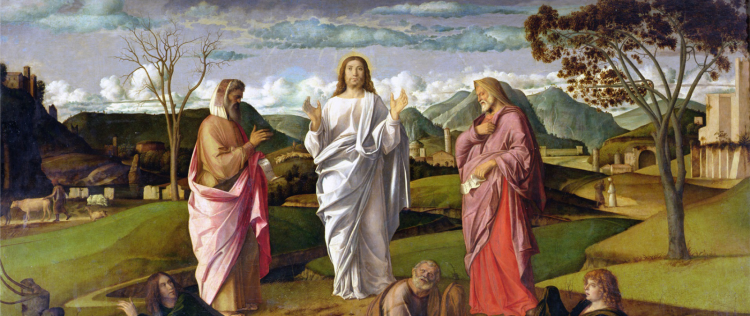

Understanding Luke’s Version of the Transfiguration
The biblical account of the Transfiguration is recorded in all three Synoptic Gospels: Mark 9:2–13; Matthew 17:1–13; Luke 9:28–36 [37-43]. Among those three, only Saint Luke provides the content of the conversation between Jesus, Moses, and Elijah.
Both Moses and Elijah held crucial positions salvation history: Moses as the amasser of Israel, and Elijah as the holder of the power to seal the heavens. The presence of Elijah and Moses on the mountain is because it was believed that they were already privileged to be with God in heaven. Moses had also experienced Yahweh on the mountain and was the first and most likely the paramount prophet to Israel and God knew him “…face to face” (Ex 33:11). Elijah was equally a great prophet and performed miracles. Eventually, Luke asserts that Jesus, was “a prophet mighty in deed and word before God and all the people” (Lk 24:19), and was the one whom Moses foretold that God would raise up in future (Dt 18:15). It had even been conjectured that Jesus could be Elijah returning (Luke 9:8; 19). Moses symbolizes the dead, whereas Elijah, given that he was carried up to heaven in a chariot of fire, represents the living (2 Kgs 1-18).
With those witnesses, then, Saint Luke’s description of the Transfiguration of Jesus into glory is collectively supported by the Law and the Prophets with those two representing the two strands of prior salvation history. Luke’s disclosure concerning that conversation is highly significant in regard to his overall account of the life of Jesus. The evangelist notes that Moses and Elijah “spoke of [the Lord’s] exodus that he was about to accomplish in Jerusalem” (Lk 9:31). The Greek term exodus (Gk. ἔξοδος) in other English translations is also rendered as “departure” or “going out”, though its relationship to Moses and Elijah is better underlined by translating it as exodus. Those two Old Testament exemplars are speaking about Jesus’ exodus from this world through His suffering, death, and resurrection into heaven, the place where Moses and Elijah already dwelt with God. Such an exodus from the world could only happen in accord with what Jesus Himself had predicted when He said this, just prior to being transfigured, “The Son of Man must suffer greatly and be rejected by the elders, the chief priests, and the scribes, and be killed and on the third day be raised” (Lk 9:22).
The Lord’s Transfiguration provides a glimpse of the coming future glory of Christ on Easter. However, it also serves to remind us that the way to Easter is through the Cross. A few verses later in this passage, at Lk 9:51, the Third Evangelist writes that Jesus “set his face to go to Jerusalem,” where all that had been spoken of earlier will take place for Him.
Though the Transfiguration is annually commemorated on August 6, how does this incident relate to Lent? A key to answering this question is found in the topic of the conversation among Moses, Elijah, and Jesus. As mentioned earlier, Luke tells us that the conversation was about the Lord’s impending exodus, which would ultimately be fulfill in Jerusalem. The Transfiguration takes place and turns the gaze of Jesus toward Jerusalem and He begins to walk the road ahead that leads to suffering. By doing so, this deepens the meaning of Lent. It reminds us that that the Lenten journey is one from darkness into light. This manifestation provides heavenly light to these human weaknesses unto which faith is often heir to: dimming vision, disillusionment, and disappointment. Yet, it is the bright promise of immortality that sustains the weary.
Excerpted from http://www.workingpreacher.org. Arland L. Hultgren. “Commentary on Luke 9:28-36 [37-43].” 14 February 2010.
 Nature and dignity