
7th Week in Ordinary Time
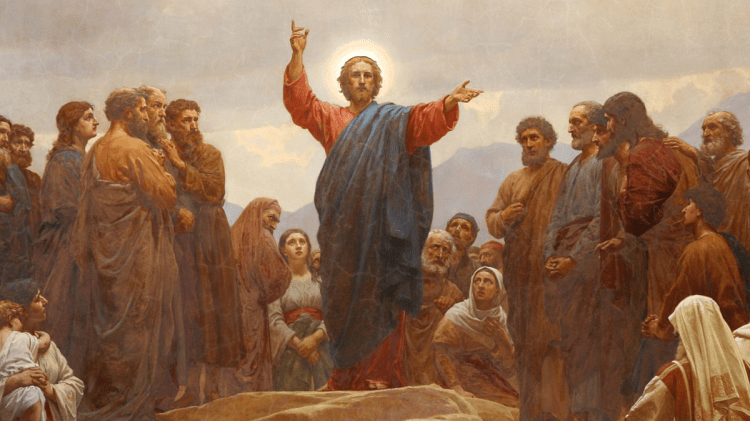

Sermon on the Plain vs. Sermon on the Mount
Nearly half of the material found in Saint Luke’s Gospel is unique and, as such, not found in any of the other three. Those differences, whether considered to be additions or omissions, if taken collectively, reveal that Jesus was most closely connected with people who appeared to be on the margins of society, yet who were ready and eager to receive the salvation that He offered them. All of this matters because it informs how Saint Luke intended for his Sermon on the Plain to be understood.
In ways that are quite touching, that Sermon reflects the Lord’s care for and His mission to the poor and outcast. This reference differs from what is referred to in Saint Matthew’s Sermon on the Mount as the “poor in spirit” or those who “hunger and thirst after righteousness.” Instead, in the Sermon on the Plain, Jesus focuses on those who are financially poor or physically hungry, when He said, “Blessed are you who are poor, for the kingdom of God is yours. Blessed are you who are now hungry, for you will be satisfied” (Lk 6:20-21). According to Saint Luke, then, the message of Jesus is one of deliverance in the here-and-now from the real-life challenges faced by those who are most in need. Moreover, Jesus is critical of those who are currently physically secure but (apparently) unwilling to take any steps to help the poor and needy. He said, “But woe to you who are rich, for you have received your consolation. But woe to you who are filled now, for you will be hungry” (Lk 6:24-25).
Indeed, the Gospel of Luke can be framed as a gospel of reversals. The poor and hungry get the Lord’s focus and His promised blessings, whereas the rich and full (who likely think they are rich and full because of being blessed by God) are the one will receive no additional reward and, in fact, end up deprived and hungry. In a similarly profound way, the Sermon on the Plain in its insistence on good, ethical behavior, is not connected to some prior teaching such as can be found in the Sermon on the Mount in which the evangelist makes allusions to the teachings of Moses. Instead, in Luke, Jesus often usually says something like this, “You have heard it said, but I say to you…” Such phraseology or its accompanying moral enjoiner is simply announced as a matter of due course. In other words, living upright is just the way people are supposed to live, “…love your enemies and do good to them, and lend expecting nothing back” (Lk 6:35), He said. Again, with respect to Luke’s emphasis on the here-and-now or today, the moral action that Luke proposes is practical behavior for what is already happening in life. Upright behavior is how disciples are supposed to act today, even toward those who hate them, curse them, or after lending others something and having the item not returned to not demand it back.
Why is all of this so different from the Sermon on the Mount? That answer to that question comes by means of the way those similar though varied teachings are summarized. In the Sermon on the Mount, Jesus summarizes His discourse on behavior with the charge, “So be perfect, just as your heavenly Father is perfect” (Mt 5:48). There you find a requirement that cannot be achieved in a given lifetime. Conversely, perfection is, simply put, not the primary concern in the Sermon on the Plain. Instead, in Luke’s version, Jesus summarizes His moral discourse in a way that is surprising and unexpected: “Be merciful, just as your Father is merciful.” (Lk 6:36). In Luke’s Gospel, mercy trumps everything else and functions as the guiding principle of life. Mercy is also meant to be extended to others. Though never easy, mercy can happen now, every day, toward everyone and anyone. The ability to extend mercy is never contingent on something else or what is due or pending. Disciples are enjoined to “be merciful” because “your Father also is merciful.”
In Greek, the root word underneath “merciful” is oiktirmón (Gk. οἰκτίρμων), which suggests tenderness and the visceral compassion that God has for those who find themselves in difficult situations. Oiktirmón is a deep sense of compassion, while it is emphasized in divine compassion, such an attitude is also meant for believers to emulate that divine attribute since merciful is how God is. In the Sermon on the Plain, first and foremost, the Father is a God of mercy. In fact, mercy (not perfection, as in the Sermon on the Mount) is the defining characteristic of God.
There are other fascinating insights to be gained from the Sermon on the Plain because it is not just “Luke’s version” of the Sermon on the Mount. It is its own discourse with its own message and its own lessons. And to be particularly clear, seeing a unique and different message in the Sermon on the Plain from that which you can see in the Sermon on the Mount does not detract the profound effect on disciples that can be derived from one or the other.
Excerpted from http://www.publicsquaremagazine.org. M David Huston. Unearthing the Overlooked Gems of Luke’s Sermon on the Plain. 24 February 2023.
 Nature and dignity