
Sixth Sunday in Ordinary Time
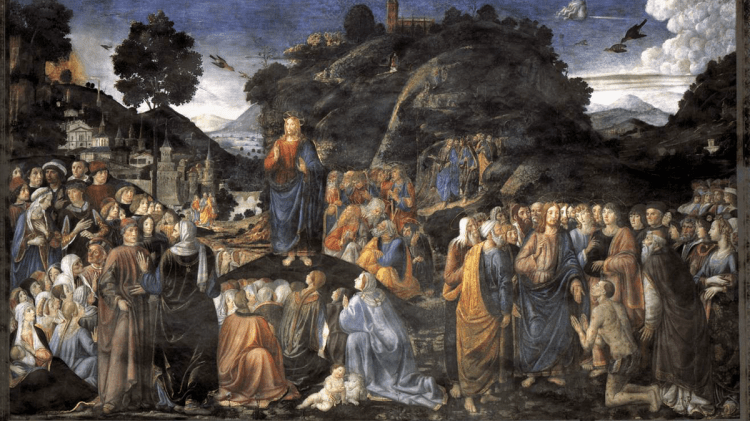

Two Versions of the Beatitudes—Matthew vs. Luke
The Sermon on the Mount related in Matthew 5-7 has much in common with the teaching of Jesus recounted in Luke 6. These two versions of the Beatitudes are best-known by what is found in Matthew (Mt 5:3-12), though, a similar, yet different version is found in Luke (Lk 6:20-26). The actual number is often debated, yet, whether counted as nine, eight or four beatitudes, they serve as the introduction to the Sermon on the Mount in Matthew’s Gospel as well as what scholars label as Luke’s version known as the Sermon on the Plain. In Matthew, Jesus speaks eight or nine blessings, but in Luke he speaks only four that are then followed by a series of “woes” in which he effectively curses people who are the opposite of those he has just declared blessed (Luke 6:24-26).
Differences
Within the Beatitudes themselves, there are at least four notable differences. The most obvious is the number: while Matthew gives us eight, those first four appear to focus on the subject’s situation and the second four focus on the subject’s character. Luke, though, only gives four. The second thing to note is that, while Matthew’s are couched in the third person (‘Blessed are those…’), which gives them a sense of sayings with a wider relevance, Luke’s are in the second person (‘Blessed are you…’) that suggests a more direct focus on the disciples to whom Jesus was speaking. The third key difference, Luke’s inclusion of the ‘woes’, has a compensatory effect, in that it is most natural to read the blessings as directed towards Jesus’ followers, while the woes are directed to those who do not take up the costly call of discipleship. This draws attention to something that both versions have in common: the introduction in both cases makes it clear that Jesus’ teaching here is, in the first instance, directed towards his disciples, who are distinguished from the crowds in both narratives, and only (as it were) hear the teaching as eavesdroppers. The four Beatitudes pronounced in Luke are all addressed immediately to the crowd, “Happy are you,” whereas the eight Beatitudes pronounced in Matthew are announced in the third person, “Blessed are they”.
St. Augustine and the Differences
Theorizing that only one sermon was delivered, then it is plausible that its location was described under different aspects by Matthew and Luke. For it is possible that for Luke the place was a level spot on the slope of the mountain, that was part of the higher mountain; thus, it might be described as a plain in relation to the mountain’s peak. According to this approach, the sermon as related by Matthew included a number of our Lord’s words that Luke omitted while Matthew omitted some of the words that Luke included. A second solution is that Jesus actually gave two sermons that were closely related: for his purpose was to promulgate the New Law, yet not all were prepared to receive that law in its most perfect form. Therefore, since the first promulgation was given only to His close disciples on the mountaintop, it was lengthier and more proportioned to the spiritual-minded. In turn, if the second was given to the multitudes on the plain or level site, it was shorter and more proportioned to those focused on physical desires or pleasure.
Fr. Servais-Theodore Pinckaers
In his monumental The Sources of Christian Ethics, the late Dominican moralist wrote, “(T)he Sermon on the Mount has been one of the chief sources of spiritual renewal known to the Church through the ages. Its fruitfulness is amply attested by its constant reappearance. There are few passages in Scripture that touch the Christian heart more surely and deeply, or that have a greater appeal for nonbelievers. The Sermon on the Mount was one of Ghandi’s favorite texts; he reproached Christians for their neglect of it” (The Sources of Christian Ethics, p.135).
His other work, The Pursuit of Happiness—God’s Way: Living the Beatitudes constitutes a more devotional endeavor than the earlier referenced magnum opus. Christian ethics, he believes, begins in the Sermon on the Mount. It is not fundamentally an ethic for the elite, only found in the evangelical counsels, nor an interim morality for those of Matthew’s day expecting an imminent return of Jesus the Christ. Neither is the Sermon on the Mount an impossible teaching that leads us to faith. Rather, the sermon, and more specifically the Beatitudes, are intended for all Christians as the way to real happiness. Pinckaers does not enter into a historical-critical exegesis of the sermon and beatitudes; rather he offers what he calls a “realistic” or spiritual reading of the text, which faith and life reveal to us.
While briefly situating the beatitudes in Matthew’s gospel and reading them in light of the Hebrew scriptures or Old Testament, Pinckaers invites readers to go beyond the words of the text to the reality signified by God’s promise to us that a life lived in faith unfolds. The new law of the sermon is the work of the Holy Spirit given to us through faith in Christ. The life promised in the beatitudes is thus a matter of graced living and not, as found in some catechetical works, a new Christian law to supplement that of Moses. The beatitudes therefore challenge our conception of happiness as individuals and they do so, corporately, as the people of God. Their paradoxical nature turns the moral world upside down. Pinckaers observes, “We need no one to teach us that good fortune and joy will make us happy. But what we could never have discovered for ourselves is that poverty and suffering could be the most direct road to happiness and that Christ has chosen them as our way to the Kingdom” (The Pursuit of Happiness, p. 35).
Source: http://www.psephizo.com. Ian Paul. “The Beatitudes in Luke and Matthew.” 15 February 2019
 Nature and dignity