
First Week in Ordinary Time
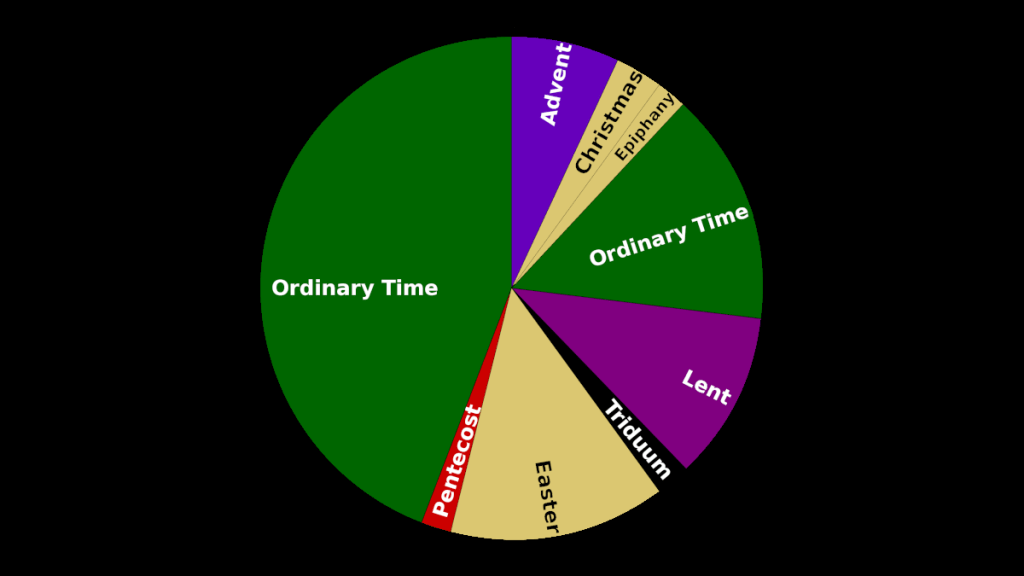

Ordinary Time—Tempus per annum—Time throughout the Year
In the liturgical calendar before the Second Vatican Council, there were basically three liturgical seasons: the season of Christmas that included Advent and up to six Sundays after Epiphany. Then there was Easter, which included Lent and three Sundays before Ash Wednesday that were called in the Roman Calendar before Vatican II Septuagesima, Sexagesima and Quinquagesima, referring to 70, 60 and 50 days before Easter respectively. And then the last was the Season of Pentecost, which continued until the subsequent Advent. So, before the Vatican Council, there was no season of Tempus per annum or Ordinary Time.
Now, according to the Universal Norms of the Liturgical Year & Calendar, you find this description, “Besides the times of year that have their own distinctive character, there remain in the yearly cycle thirty-three or thirty-four weeks in which no particular aspect of the mystery of Christ is celebrated, but rather the mystery of Christ itself is honored in its fullness, especially on Sundays. This is known as Ordinary Time” (UNLYC, n. 43). Then, the Universal Norms add, “Ordinary Time begins on the Monday which follows the Sunday occurring after January 6 and extends up to and including the Tuesday before the beginning of Lent; [ordinary time] begins again on the Monday after Pentecost Sunday and ends before First Vespers [Evening Prayer I] of the First Sunday of Advent” (UNLYC, n. 44).
Since Ordinary Time begins on a Monday, there is no day called the “First Sunday in Ordinary Time”. Instead, the lowest-numbered Sunday is called the Second Sunday in Ordinary Time. Meaning the first Sunday after the start of Ordinary Time is technically considered the “Second Sunday in Ordinary Time” as the weeks are counted forward from the first week of the season. This arrangement usually coincides with the Feast of the Baptism of the Lord, which takes precedence over the first Sunday of Ordinary Time.
The weeks of Ordinary Time are counted forward from Christmastide to Lent, and in reverse from the 34th week before Advent back to Pentecost. There are propers for days of the weeks of ordinally counted time. Those 33 or 34 weeks are not all full weeks of days, however, because some of them are incomplete weeks: the first week of Ordinary Time, the week in which Ash Wednesday falls, and the week following Pentecost Sunday, those are always incomplete weeks.
The Liturgical Year is not a mystery play nor a chronological timeline that unfolds the historical life of Christ. “..[It] is not a cold and lifeless representation of the events of the past, or a simple and bare record of a former age. It is rather Christ Himself who is ever living in His Church” (Pius XII, Mediator Dei, n. 165).
 Nature and dignity