Fourth Sunday of Advent
The Blessedness of the Virgin Mary
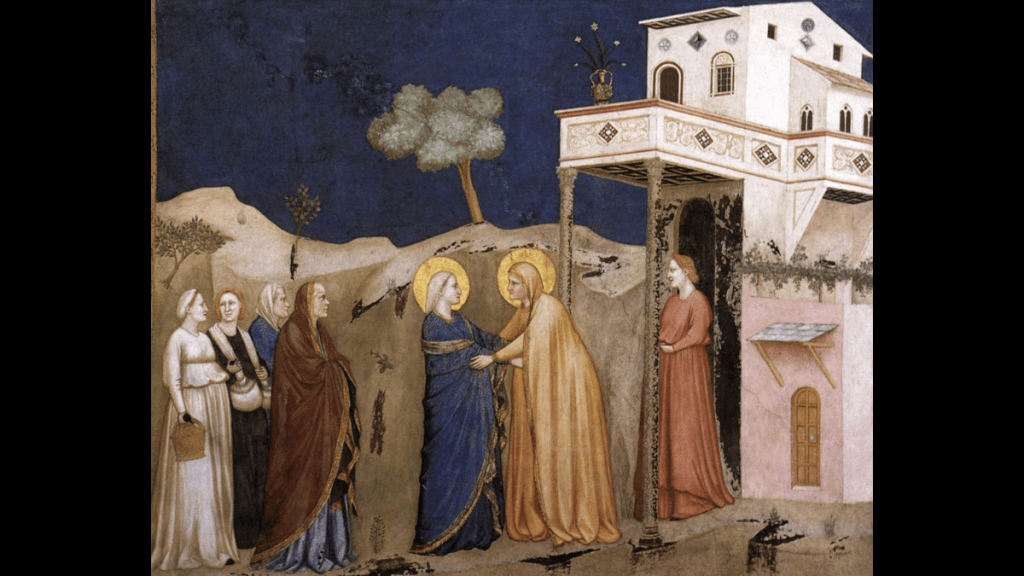
Having heard from the angel Gabriel that she was to be the Mother of God, Mary immediately set out to visit Elizabeth, her kinswoman. Upon arriving in the hill country, upon hearing Mary’s voice, the unborn son in Elizabeth’s womb quickens and fulfills Gabriel’s earlier prophecy, “…he will be filled with the holy Spirit even from his mother’s womb…” (Lk 1:15). Already John points to the coming one; the unborn child’s leaping (Gk. ἐσκίρτησεν) is prompted by the Spirit.
Yet, it is Elizabeth, the Baptist’s mother, who takes on the role of prophet by speaking the prophetic word. She, too, is filled with the Holy Spirit and proclaims what Mary has not yet told her, nor what is not yet visible to the eye: Mary is with Child. Furthermore, through the Spirit she knows who this Child will be, for she calls Mary “the mother of my Lord.” Her prophecy will soon be fulfilled when John, her own son, prepares the way for the Lord.
Elizabeth not only prophesies but she also blesses. By declaring both Mary and the fruit of the virgin womb to be blessed, Elizabeth begins a series of blessings that are weaved throughout Saint Luke’s birth narrative and serve to intensify its tone of joy, delight, and praise. Eventually, Mary, Zechariah, and Simeon will all add their blessings to that sacred chain, praising God for what He was doing at that moment in salvation history and recognizing that those who are privileged to be instruments of God’s saving work have been richly blessed. Mary is blessed not only for her status as the mother of the Lord, but also for her trust in God’s promise.
Our English biblical translations obscure the fact that Elizabeth uses more than one Greek word for bless, though the two words are both rendered in English as “blessed.” When she pronounces Mary “blessed … among women” and proclaims that the fruit of Mary’s womb is blessed, Elizabeth uses the term Greek eulogemene (Gk. εὐλογημένη), which emphasizes that both present and future generations will praise and speak well of Mary and her Child. Subsequently, when she says, “Blessed are you who believed that what was spoken to you by the Lord would be fulfilled” (Lk 1:45), Elizabeth uses the word makaria (Gk. μακαρία), the same term that Jesus will eventually use to bless people in the Beatitudes. You could translate Elizabeth’s words as “Happy is she who believed …” Thus, Mary is blessed and, greatly so, that she remains ever-Virgin: before, during, and after Christ’s birth (ante partum, in partu, et post partum). Despite all societal expectations, any hint of shame related to Mary’s being with Child and a perpetual virgin has been reversed: she will be honored rather than shamed for bearing God’s Son.
Yet, she has also been blessed with divine joy — with true blessedness or beatitude — because Mary believed that God would be able to do what the Father had promised to do. Elizabeth says, “Blessed are you who believed that what was spoken to you by the Lord would be fulfilled.” Implicitly, in saying so, her cousin contrasts Mary’s trust in God’s power and promise with her husband Zechariah’s skeptical questioning. Zechariah asked for proof that the angel’s words to him were true. On her part, Mary only asked for an explanation of what was going to happen to her, and then gave her willing consent or her fiat. Zechariah the religious professional doubted God, but Mary the peasant girl believed. Her trust in God’s word opened the door for God the Father to bless her and to bless the whole world through her. In the Visitation, Elizabeth celebrates Mary’s willingness to say “yes” to God.
Excerpted from http://www.workingpreacher.org. Judith Jones. “Commentary on Luke 1:39-45.” 20 December 2015.
 Nature and dignity