
Seventh Sunday of Easter for Year B ~ John 17
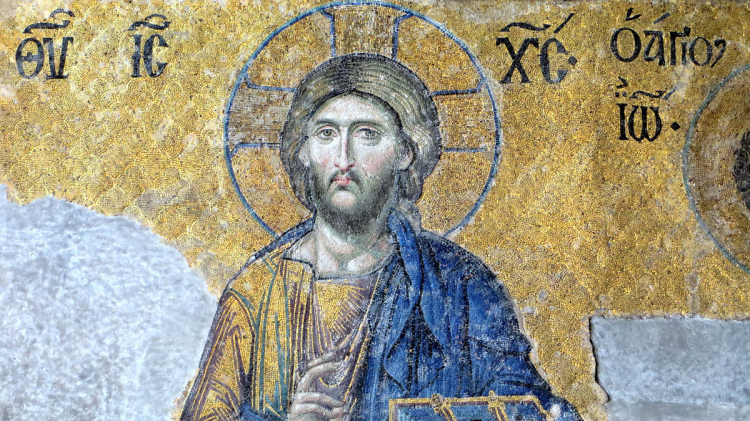
This week’s Gospel contains the latter part of what scholars call the High Priestly Prayer of Jesus. The late Pope Benedict XVI, in a General Audience address (25 January 2012), described that entire seventeenth chapter of Saint John’s Gospel as this: “the prayer that Jesus raises to the Father in the ‘Hour’ of his exaltation and glorification (cf. Jn 17:1-26). As the Catechism of the Catholic Church says: “’Christian Tradition rightly calls this prayer the “priestly” prayer of Jesus. It is the prayer of our High Priest, inseparable from his sacrifice, from his “passing over” (Passover) to the Father to whom he is wholly consecrated’” (CCC, n. 2747).
The New Interpreter’s Bible outlines this chapter in terms of three sections: (1) Jesus prays for His glorification (Jn 17:1-8); (2) The Lord intercedes for the community of faith (Jn 17:9-23) and, (3) He prays for the eschatological union between Father, Son, and believers (Jn 17:24-26). In this chapter, Jesus speaks as an intercessor, His words addressed directly to God the Father and not to the disciples, who supposedly only overhear. Thus the prayer is one of petition for immediate (Jn 17:6–19) and future (Jn 17:20–21) disciples. Many of its theologically-rich phrases are reminiscent of the petitions found in the Our Father. So, the Lord’s high priestly prayer fulfills, when understood from within, the great petitions of the Lord’s Prayer: concern for the Father’s name; passionate zeal for his kingdom (glory); the accomplishment of the will of the Father, of his plan of salvation, and deliverance from evil.
The Content of the Prayer
In the New Testament, it is primarily the Letter to the Hebrews that sets forth and expands on Jesus’ high priestly role. The New Testament as a whole depicts Jesus in His three roles as Prophet, Priest, and King or the Munus docendi – The duty to teach, based on Christ’s role as Prophet; Munus sanctificandi – The duty to sanctify, based on Christ’s role as Priest and, finally, the Munus regendi – The duty to shepherd, based on Christ’s role as King.
Regarding His prophetic office, Jesus acts as a Prophet when clearing the temple during His first visit to Jerusalem on the occasion of the first Passover recorded in the Fourth Gospel (Jn 2:13–22). He also assumes the prophetic role when people see the messianic sign that Jesus performed when feeding the five thousand. They said, “This is truly the Prophet, the one who is to come into the world” (Jn 6:14).
With regard to Jesus’ role as King, immediately after the feeding of the five thousand, the crowd sought to compel Jesus to be their king by force, “Jesus knew that they were going to come and carry him off to make him king (Jn 6:15). In the third role or munus, during His triumphal entry into Jerusalem just before the crucifixion, Jesus mounts a young foal and rides into the city in Solomonic fashion (Jn 12:12–19). It is emblematic of His regal humility (Jn 12:14) and in fulfillment of the Old Testament prophecy of Zechariah, “Exult greatly, O daughter of Zion…Behold, your king is coming to you…Humble, and riding on a donkey, on a colt, the foal of a donkey” (Zech 9:9).
The third munus or the priestly office of Jesus is not explicitly developed in the Gospel of John to the same degree as His other two roles as Prophet and King. Nevertheless, Christ’s death on the cross is presented in sacrificial terms. He is “the Lamb of God” who dies to “take away the sins of the world” (Jn 1:29, 36). Jesus is the “Good Shepherd” who gives His life for His “sheep” (Jn 10:15, 17–18). As the Jewish high priest that year,
Caiaphas rightly—albeit unknowingly—prophesied, that Jesus was the “one man” who died for the sins of the people saying, “You know nothing, nor do you consider that it is better for you that one man should die instead of the people, so that the whole nation may not perish…and not only for the nation, but also to gather into one the dispersed children of God” (Jn 11:49-50, 52). Unbeknownst to Caiaphas, he prophesied that this one man would die, not only for the Jewish people, but also that the Gentiles could be offered salvation. In this prayer, by fulfilling this priestly, intercessory function, and paradoxically serving both as High Priest and as the perfect sacrifice, it was truly Jesus who served as High Priest even though Caiaphas formally held that office.
In the final verses of this week’s Gospel, Jesus says, “…I consecrate myself for them, so that they also may be consecrated in the truth.” The Lord asks the Father to give His disciples four gifts: unity, joy, preservation, and holiness. The truth of which Jesus speaks is both the active force of their consecration as well as the sphere into which the believer is placed. Those consecrated by the Word become united with Christ, who is Himself the Truth (I am the Way and the Truth, and the Life). This is the Lord’s other prayer that the disciples may live in His Truth, sanctified, made holy, by the truth of their faith in Him.
Excerpted from Andreas Köstenberger, “The context of Jesus’ prayer (John 17),” at www.st-ignatius.net.
 Nature and dignity