
The Ascension of the Lord Jesus into heaven is a mystery rooted in history and spoken of in Scripture, like the Resurrection. It is presented both at the end of Matthew’s Gospel and at the beginning of the Acts of the Apostles. According to the Catechism of the Catholic Church (no.665), “Christ’s ascension marks the definitive entrance of Jesus’ humanity into God’s heavenly domain, whence he will come again (cf. Acts 1:11); this humanity in the meantime hides him from the eyes of men (cf. Col 3:3).”
Chapter 24 of Saint Luke’s Gospel is composed of several segments: the Lord’s appearance to the disciples in Jerusalem (vv. 36–43); Jesus’ final instructions (vv. 44–49); and the Ascension (vv. 50–53). Thus, after having a meal with the Apostles and teaching them, Jesus tells them this: “And [behold] I am sending the promise of my Father upon you; but stay in the city until you are clothed with power from on high” (Lk 24:49). In the following verse, then, the Risen Christ ascended back to heaven. On Ascension Thursday, the Church rejoices in the lifting up of human nature into heaven in the Person of Christ, by whom humanity and divinity are brought together. This took place on the fortieth day after His rising from the dead. He tells the disciples to wait in the city in order to receive the promise of the Father or the Holy Spirit.
From Ascension to Pentecost, there is a nine-day period of waiting and the tradition of the practice of a novena has been derived from it. A novena is understood as nine consecutive days that focus on praying for an explicit intention. In praying so consistently, for over more than a week and by doing so for a specific request that is repeated nine days in a row, the spiritual practice serves as a helpful discipline to grow in consistency in the life of prayer. It also imitates the persistent widow that Christ used as an example of prayer, who did not stop pleading with the judge after her first request was denied (Lk 18:1-8). The woman goes before the unjust judge with her petition over and over, refusing to take no for an answer. The widow was resilient and undauntingly faithful to what she believed to be the legitimacy of her request.
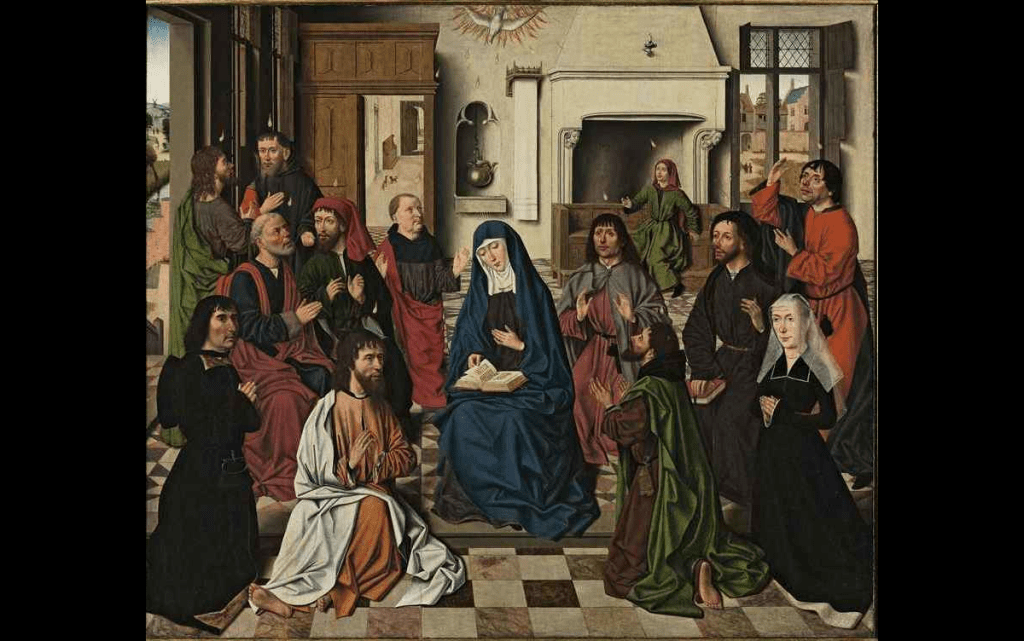
During this nine-day period, between Ascension and Pentecost, the Apostles gathered together with many other disciples who, by then, numbered about 120 persons, according to Acts (1:15); during this time Matthias is chosen by lot to replace Judas as an Apostle. On the tenth day, the day of Pentecost, the Holy Spirit is poured out upon the Apostles (Acts 2:1-13), and though the crowd spoke many languages, “each one heard them speaking in his own language” or xenoglossia (Gk. ξένος + γλῶσσα). Emboldened by the Spirit, Peter preaches the Pentecost sermon in that same chapter of the Acts of the Apostles, “Those who accepted his message were baptized, and about three thousand persons were added that day” (Acts 2:41).
 Nature and dignity