
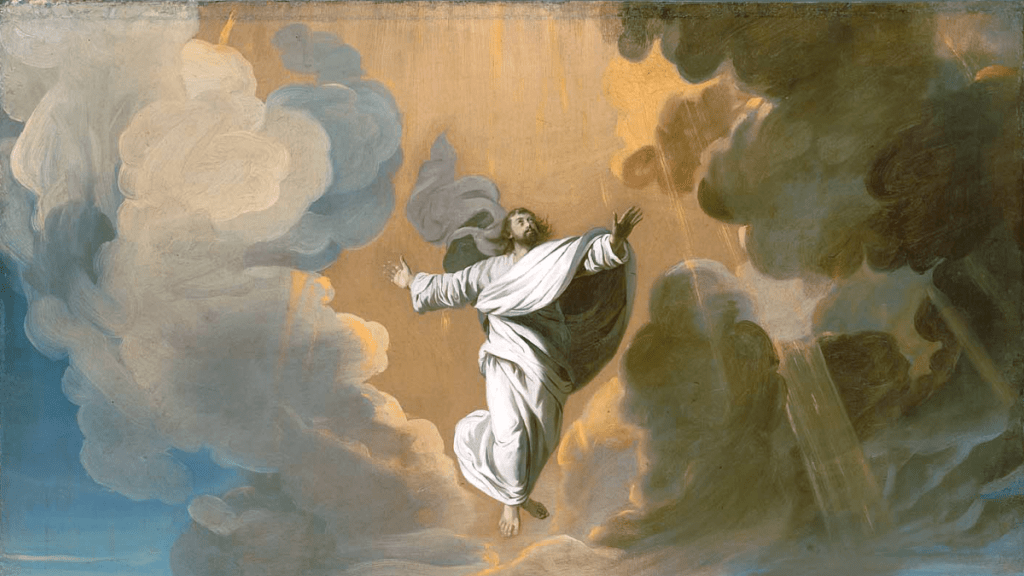
The Ascension is the completion of the Lord’s Paschal Mystery: His life, passion, death and resurrection. Moreover, this feast is the final step before the coming of the Holy Spirit at Pentecost. As the Catechism of the Catholic Church states: “Christ’s ascension marks the definitive entrance of Jesus’ humanity into God’s heavenly domain, whence he will come again (cf. Acts 1:11); this humanity in the meantime hides him from the eyes of men (cf. Col 3:3)” (CCC, n. 655). In the Apostles’ Creed, we profess to believe that “he ascended into heaven” and that declaration of faith is substantiated by the Acts of the Apostles, “When he had said this, as they were looking on, he was lifted up, and a cloud took him from their sight” (Acts 1:9). Thus, after forty days of post-resurrection appearances and speaking to the Apostles about the coming of the Spirit, the Risen Jesus “was lifted up, and a cloud took him from their sight.”
The actual location as to where the Ascension took place is either somewhere in Jerusalem due to the reference that the apostles “returned to Jerusalem from the mount called Olivet” or, according to the first volume of Luke-Acts, the Lord’s ascending back to the Father took place at “Bethany…As he blessed them he parted from them and was taken up to heaven” (Lk 24:50-51). This Lukan appearance narrative seems to go on to describe how Jesus then led his disciples out from the upper room to Bethany for his final departure from them (Lk 24:50). However, Luke does not connect the events together, but just describes them as happening one after the other; and it is unlikely that you should conclude that late in the evening of Easter Sunday Jesus would lead his followers out of the city to Bethany for a final farewell in the dark (Lk 24:50-51). This is confirmed by the opening chapter of Luke’s sequel, the Acts of the Apostles, which declares that after his resurrection, the risen Jesus was planning to spend more time instructing his followers, before departing from them later to return to his Father (Acts 1:1-5).
Behind Luke-Acts you find the biblical basis for the early Church’s unequivocal belief that Jesus was vindicated by the Father after His crucifixion. This mystery is expressed in the language of exaltation, heavenly session, and resurrection. Christ’s ascension and his being seating (or session) at the right hand affirms that redeemed humanity is in heaven and, moreover, that it is possible for us to become God-like. Even more so, this event in the life of the Risen Christ serves as a reminder that the risen life He has promised we can possess, when we do, that perfect life will have a purpose, just as this life has a purpose. That purpose is union with God. Human beings, in all their evident fragility, are promised that, as the Letter of Second Peter puts it, “you may come to share in the divine nature” (2 Peter 1:4).
The exaltation of God flows from having a higher or exalted view of God. Creatures should esteem God rightly for the greatness of His attributes and works, even as we grapple with His incomprehensibility. Heavenly session (or seating) means that Christ is at the right hand of the Father. The right hand of God is a position of power and a reference to the role of Christ as King. Yet, while ascended into heaven, the Risen Christ promised those who saw Him being lifted up, that, one day, He would return in the same way He left them.
Excerpted from Jack Mahoney, SJ. The Ascension and Pentecost with St Luke.” http://www.thinkingfaith.org. 13 May 2010
 Nature and dignity