
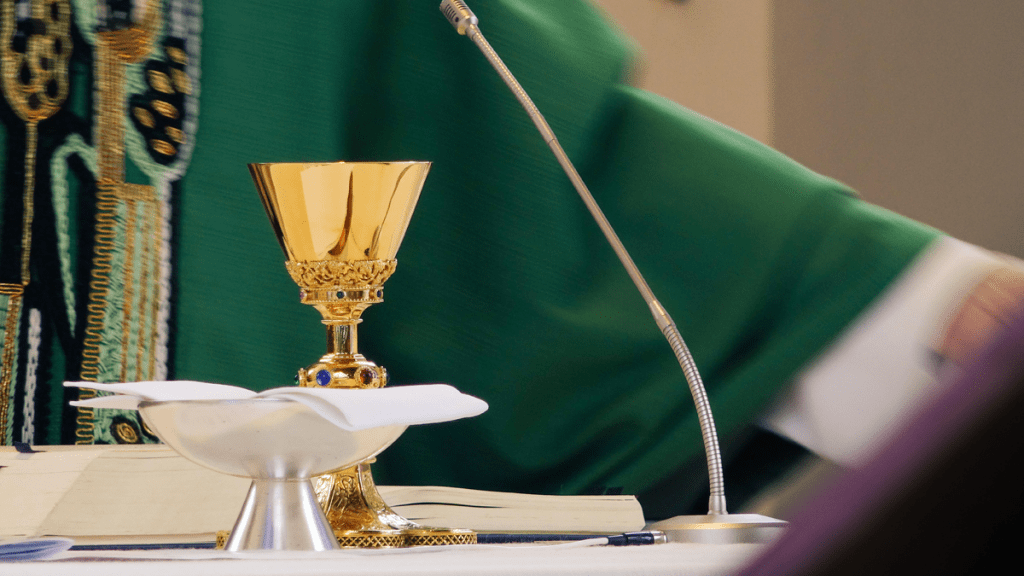

Table Koinonia as Communion with Christ & Other Faithful
Today’s Gospel according to Saint Luke immediately follows the passage concerning the Lord’s accompanying the disciples after Jesus’ appearance to the two disciples on the road to Emmaus. Those two incidents are linked by the Gospel’s opening verse, “The two disciples recounted what had taken place on the way, and how Jesus was made known to them in the breaking of the bread.” Like most of the post-Resurrection appearances of the Risen Jesus, He greets them with this gift, “Peace be with you.” Having witnessed the Crucifixion and fearful for their own lives, true peace is what they need more than anything else. Often, the Lord’s gift of peace entails another gift, which is mentioned in the closing verses—repentance, for the forgiveness of sins.
Despite extending His peace to them, the disciples “were startled and terrified” and mistook the Risen Lord as a ghost. To counteract those adverse reactions, Christ urges the fearful disciples to use their sensory perception to dispel their terror. Though risen, still bearing the marks of His death on the Cross, they can still sense that somehow the Risen Lord still has “flesh and bones.” The horror of Calvary, though still burned in their memories, gradually yields to joy and utter amazement.
This was equally true in Saint John’s account of the Lord’s appearance to seven disciples (Jn 21:1-14) who after a unsuccessful night of fishing are ordered by the Stranger on the shore to go back out again. Catching an abundance of fish, they recognized the Stranger as Christ and had breakfast with Him. Likewise, in Saint Luke’s passage, He asks them, “Have you anything to eat?” Jesus took baked fish and ate with them.
At the time of Jesus, eating together was the primary way of marking any significant event, both social and religious. There were prescribed rituals for preparing for eating. The host had to extend gracious hospitality to his guests: the feet of the guests were washed, kisses were exchanged and the head was anointed with perfumed oil in some cases. The extent to which these rituals were observed might also be an indication of the esteem in which the host held his guests. Thus, the observant Jew was selective about what was eaten along with who was present. Eating together created a bond among those sharing food and, therefore, the selecting of guests was highly significant.
On at least eight occasions, in Saint Luke’s Gospel, Jesus can be seen sitting down to meals with others. In two additional accounts, a meal seems to be implied. When taken together, those accounts indicate the full significance of meals in the life and work of Jesus. Characteristics of Jesus’ table-fellowship include the treatment of sinners and other outsiders, the treatment and place of women, the special place of the poor, the love of neighbor, and love for an enemy. Eating together reveal Christ’s attitude to the social norms of HIs time, both in how diligently He observed them and in His departure from conforming to those expectations.
As further proof of His identity and of His resurrected body, Jesus eats with His disciples. The disciples came to know Jesus, in His most intimate nature, through the meals that He shared with them. Descriptions of these meals are a defining element of Saint Luke’s Gospel. By eating together with them, after His Resurrection, Jesus recalls all those prior meals and, most importantly, He calls to mind the Last Supper. Saint Luke’s account of the Last Supper (Lk 22:7-38) and the meals that Jesus shared after His Resurrection unveil the significance of the Eucharist. Having shared “a piece of baked fish” with His disciples, Jesus now uncovers for them the significance of what had been written about Him in the Hebrew Scriptures.
Every Mass is an encounter with Christ, achieved through both Word and Sacrament. As Jesus commissioned His disciples to be witnesses to what the Hebrew Scriptures had foretold, whenever the Church celebrates the Eucharist, Christ continues to commission those who participate to go forth and to announce the good news of Jesus’ forgiveness of sins. In addition to the dismissal “The Mass is ended, go in peace (Lat. Ite, missa est),” several new options were added: Go and announce the Gospel of the Lord (Lat. Ite ad Evangelium Domini annuntiandum). Go in peace, glorifying the Lord by your life (Lat. Ite in pace, glorificando vita vestra Dominum). Go in peace (Lat. Ite in pace). Taken collectively, these priestly words of dismissal at Mass, emphasize the missionary spirit that should take the faithful from being nourished to sharing the good news with the whole world.
We come to Mass, as disciples who are hungry again, having been fed, we are sent back to where we came from in order to transform the world in which we live by our participation in the saving-deed of Christ, enshrined in the Mass.
 Nature and dignity