
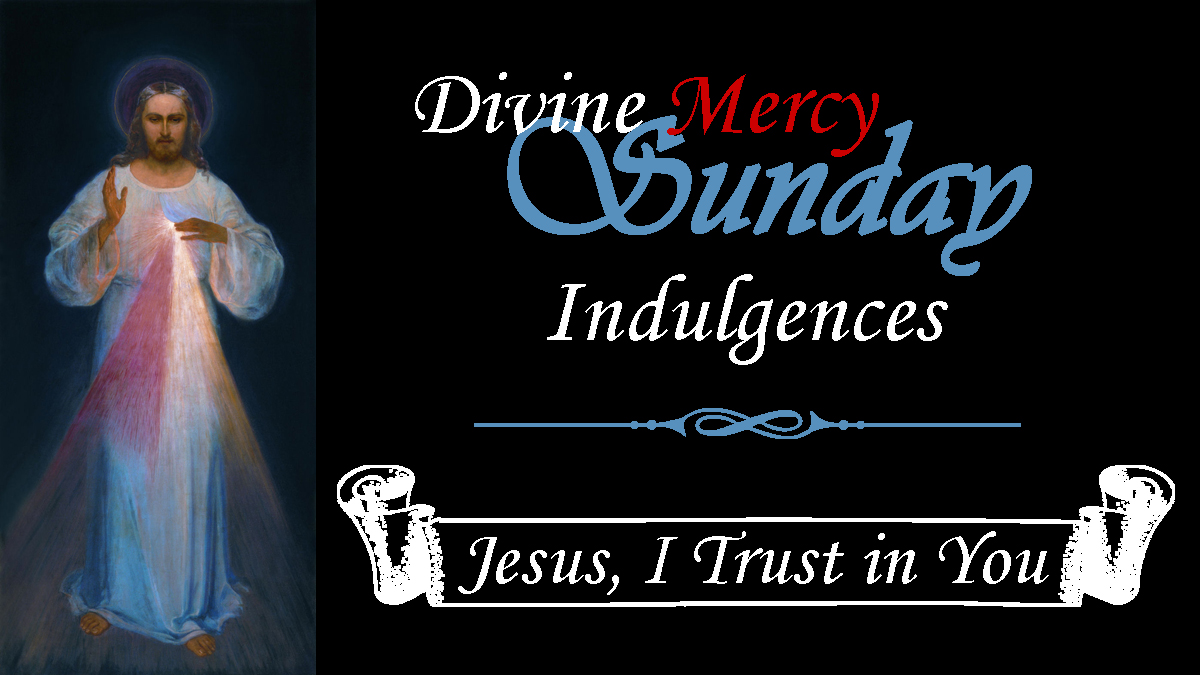
Lord God, your mercy knows no bounds,
therefore, I put my trust in you. Amen.
One of the central messages to St. Faustina is enshrined in the Chaplet of Divine Mercy. Usually done with the rosary, the chaplet holds with it powerful promises from Jesus, especially if it is prayed by, with, or for the dying. Along with the chaplet, Jesus asked that the Feast of Divine Mercy, known today as Divine Mercy Sunday or the 2nd Sunday of Easter, be preceded by a Novena to Divine Mercy meant to begin on Good Friday. Thus, during the Novena to Divine Mercy, the Chaplet of Divine Mercy is to be prayed each day for a specific intention. The Lord told St. Faustina, “I desire that during these nine days you bring souls to the fountain of My mercy, that they may draw … strength and refreshment and whatever grace they need in the hardships of life, and especially at the hour of death” (Diary, 1209).
Understanding Indulgences
An indulgence can be either plenary (or complete) or partial and it is a remission of the temporal punishment due to sin, that is, the consequences that result from sinful actions. Well, what are the consequences caused by sin? By venial sin, our relationship with God is harmed. By mortal sin, it is destroyed and eternal (not temporal) punishment is incurred.
By sin of any kind the soul is damaged to a certain degree. Repeated bad actions often become bad habits that are called vices such as pride, vanity, envy, sloth, anger, greed, gluttony, lust, resentment, selfishness…Vice makes people vicious, that is, filled with vice, and it destroys individual happiness that spreads out to everyone with whom your life intersects. So, sin harms other people and causes a ripple effect that floods out into the world affecting all humanity. Thus, obtaining an indulgence is something offered to the faithful by the Church, as the keeper of the keys of the kingdom, she being endowed with divine authority to bind and loose. Any plenary indulgence granted by the Church involves the fulfillment of a number of conditions, including these: prayer for the Holy Father’s intentions, Confession, and Holy Communion, and the carrying out of the special indulgenced work – in this case: participating in public devotions to the Divine Mercy on Divine Mercy Sunday itself.
General Conditions for Obtaining Any Plenary Indulgence
- 1. Sacramental confession – usually within twenty days before or after the activity
- 2. Receive communion – preferably on the day of the indulgenced action. (While it is appropriate that the two sacraments be received on the same day, the Church permits them to be received up to about 20 days before or after the day the indulgenced work is performed.)
- 3. Prayer for the intentions of Supreme Pontiff – not specified but usually the Our Father, Hail Mary, and Glory Be.
Specific Conditions for the Indulgence of Divine Mercy
On Divine Mercy Sunday
a) in any church or chapel, in a spirit that is completely detached from the affection for sin, even venial sin, take part in the prayers and devotions held in honor of Divine Mercy
OR
b) in the presence of the Blessed Sacrament exposed or reserved in the tabernacle, recite the Our Father and the Creed, adding a devout prayer to the merciful Lord Jesus, such as Merciful Jesus or I trust in you!
Partial Indulgence:
A partial indulgence is granted to the faithful who, at least with a contrite heart, pray to the merciful Lord Jesus a legitimately approved invocation, such as Jesus I trust in You, My Jesus have mercy or any other approved invocation.
If it is impossible to do even the above:
With a spiritual intention unite yourself with those carrying out the prescribed practice for obtaining the Indulgence in the usual way and, in your heart and mind, offer to the Merciful Lord a prayer interceding for the sufferings or the illness of another and the difficulties of their lives, with the resolution to accomplish as soon as possible the three conditions prescribed to obtain the plenary indulgence.
Spiritual Effect of the Divine Mercy Indulgence
By the Divine Mercy Indulgence, God promises something like the following, “I will take care of the people you have harmed. You don’t have to worry about that any longer. I won’t hold you responsible for the ripple effect of evil any longer.”
The Catechism of the Catholic Church reminds us that you can gain an indulgence not only for yourself or others who are alive, but for a deceased person (CCC, n.1032). The souls in purgatory, still in need of purification from the vestiges of sin, are not able to do anything to help themselves be purified. Like those who are alive, while those souls cannot fix the damage they had done to others or the ripple of evil in the world; however, due to the communion of saints, the living can gain the Divine Mercy indulgence for them. This is a great act of Mercy on our part.
 Nature and dignity