
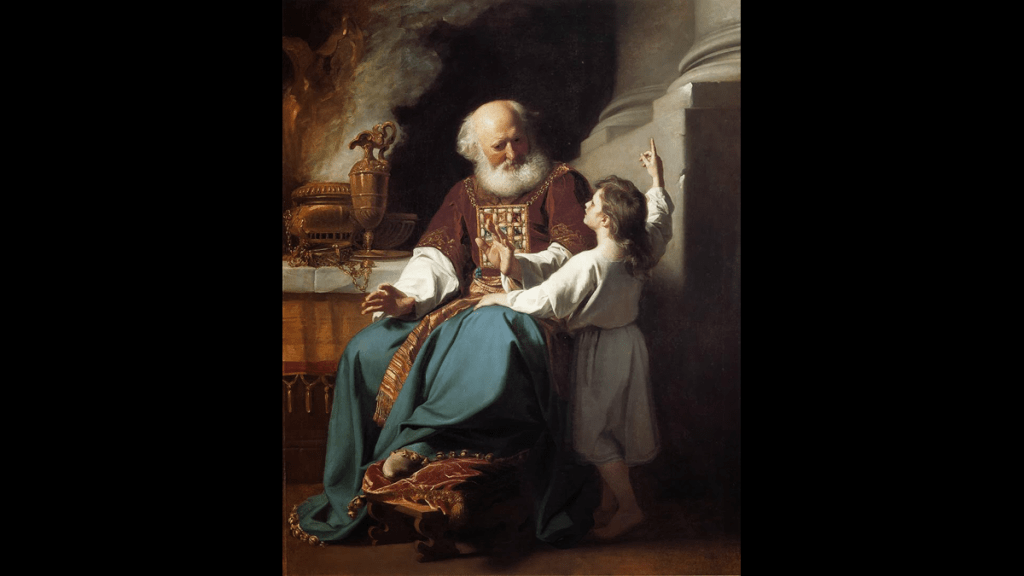

Second Sunday in Ordinary Time ~ 1 Samuel 3:3b-10, 19; John 1:35-42
The Gospel in Ordinary Time is chosen primarily from the Synoptic Gospels — Matthew in Year A, Mark in Year B (supplemented by John), and Luke in Year C. The passages ARE chosen according to a principal called lectio continua, or continual reading or, occasionally, semi-continuous reading. Thus, each Sunday, when you go to Mass this year, during Year B, you are going to hear the Gospel of St. Mark. The Old Testament reading is selected because of the harmony or the relationship it shows with the Gospel. Usually that connection (not always, though regularly) is done by a technique known as typology. In other words, the first reading is meant to highlight some event or teaching enshrined in the Old Testament and is considered to be a prefiguration or a prototype that points forward to its ultimate fulfillment in the life of Christ.
One of the fascinating, though little appreciated, aspects of the four Gospels is that while many questions are attributed to Jesus, the Lord Himself rarely gives direct answers to the questions put to Him. Moreover, even the answers that Jesus does give are often cryptic or puzzling in nature. The very first words attributed to Jesus in Saint John’s Gospel is the question heard in today’s gospel, “What are you looking for?” The question is addressed to two of the disciples of John the Baptist. Those disciples respond to Jesus in this way, “Where are you staying?” The response carries with it this unspoken request: “We want to come to talk with you.” Moreover, the reply that Jesus gives them demonstrates clearly that He is attuned to their query by saying, “Come and you will see.”
The reading from the first Book of Samuel complements the Gospel in that passage illustrates the unexpected twists and turns that can come into anyone’s life when divine invitations are heard and responded to. Context is helpful in coming to understand the implications of what the Scriptural pairing of Samuel and Eli imply. Eli’s mother Hannah was Elkanah’s second wife. His first wife Peninnah had borne him many sons and daughters, and she had fallen into the practice of taunting Hannah because, as the first wife, Hannah was unable to bear Elkanah a son. One day Eli, a priest in the temple, noticed Hannah praying and weeping, and because he saw her lips moving and heard nothing, he concluded that she was inebriated, though, in fact, she was praying to God that she could have a son, and she added that if God heard her prayer, she would give the child up to service in the temple (1 Sam 1: 9-19). When Eli challenged her about being under the influence, she explained to him the reason for her sadness and bitterness. In response Eli said to Hannah: “Go in peace, and may the God of Israel grant you what you have requested” (1 Sam 1:17).
In due course, Hannah gave birth to Samuel, and true to her promise, Hannah, accompanied by Elkanah, handed their young boy over to Eli. Which is why, when God’s call came to Samuel, he was living with Eli the priest of Israel. It is important to also know that Eli, though a man of God, did not correct his two wicked sons, Hophni and Phinehas, who served in the tabernacle alongside their father. It was said that the two sons “were wicked; they had respect neither for the Lord, nor for the priests’ duties towards the people” (1 Sam 2:12-13) and, so, they were considered unfit to succeed Eli. When Samuel was old enough, he became Eli’s assistant. As for Samuel’s parents Hannah and Elkanah, they went on to have three more sons and two daughters. Samuel became recognized as God’s prophet throughout the Kingdom, from Dan in the far north to Beersheba at the southern border.
In today’s passage, after hearing his name called four times in the night, Samuel finally greets the One who called and beautifully responds with the words prompted by Eli, “Speak, for your servant is listening” (1 Sam 3:10). However, Samuel also heard the hard truth that Eli’s family was condemned because of their disrespect for God. The significance of God’s call to Samuel is not only shown in his being an obedient servant of the Lord and a faithful prophet, but God’s call to Samuel was also significant because Samuel was destined to be the prophet who would, one day, anoint David as King of Israel.
 Nature and dignity