
The dozen days that mark the period between the Savior’s birth and the coming of the Magi constitute a period of religious feast days celebrated among the Catholics in medieval and Tudor England – twelve days of religious celebrations, feasting and entertainment that lasted all the way up to the Eve of Epiphany or Twelfth Night. Today, in addition to Christmas as the day honoring the Incarnation, along with the intervening days commemorating the cortege of honor in regard to the Companions of Christ (Lat. Comites Christi), this series of days includes both the Solemnity of Mary, the Holy Mother of God on January 1st and the Lord’s Epiphany, celebrated this year on January 7th. The two feasts are intimately connected to Christmas and, hence, to each other. Those two pivotal days feature, respectively, the visit of the shepherds to Bethlehem and subsequently the Magi arriving there, too. What is the mind of the Church who observes those feasts? It is likely she wants to provoke and deepen through those two feasts.
Why begin each new civil year with pondering Mary’s Motherhood? Most of us, on December 31, observe that eve not thinking about Mary, but often reminiscing about what the year about to finish has wrought: the good memories, the difficult crosses. It is a time to look back and recall with joy the happy times, the births, the weddings, the reunions, the achievements in school or work or elsewhere. The year ending also provokes some nostalgia and even sadness due to the deaths or sufferings of loved ones, the pain of relationships and friendships that have broken down, the personal and familial consequences of this never ending pandemic, the economy and more. The reason why the Church proposes that we mark a Marian feast on beginning on New Year’s Eve or the Vigil is precisely because of what is recorded in St. Luke’s Gospel about the shepherds because the Holy Mother Mary teaches us how to “contemplate things in our heart,” to “treasure” the graces, to ponder the Crosses. Mary also teaches her spiritual children how to ponder the meaning of the visit of the Wise Men to Bethlehem that is the perennial conversation the Lord engages in with the universal Church on the Epiphany. Remaining behind with Mary and Joseph, even after the shepherds leave, the Church waits to receive the Magi.
The first thing we learn from those Wise Men is the importance of seeking God. When they saw the star at its rising, they not only interpreted it to mean that God was trying to communicate something to them in general, but that God was specifically heralding the birth of the newborn King in the east, who was divinely destined to be a universal king. The stars as many people realize were incredibly important to ancient people. Millennia ago, in the deserts of the Middle East and on the Mediterranean Sea or Mare Nostrum, travelers and sailors were highly dependent on the fixed stars in the sky as references for how to move about on land or sea. Those people firmly believed that God had made the celestial bodies for a given reason. Whenever anything happened in the sky that was new — like the appearance of a comet, a meteor shower, or a planet or star shining more brightly than others — the ancients thought that it had to bear some message from God, the Creator of the heavens and the earth. When the Magi saw this unique star at its rising, they did not respond as curious astrologers but as Wise Men who hungered to find what they sought. Led by the star, and their simple faith in its meaning, the Magi went on a journey toward a foreign land.
The second thing the Wise Men illustrate is that the life of faith in God is to be understood as a pilgrimage. Those three men were ready to move and eager to go. Even though they must have had good lives where they were living since they could afford such a long journey and precious gifts at their arrival, the Magi accounted being with the newborn universal king more important than staying in their native place. They were willing to leave everything behind and make a long, difficult journey, following the star that they had seen in the East. They also show us that our own pilgrimage of life is not one that we were meant to make alone. The Three Kings knew that, in order for them to reach that unknown destination, they needed each other, but more than that, they wanted to make the journey together. Similarly, the Catholic pilgrimage of faith is not a go-it-alone endeavor, but a lifelong journey that requires the help of many others, known and unknown. The Magi illustrate in miniature, how our encounter with Christ is meant to change us.
Saint Matthew says that the Wise Men returned home “by another route,” a reference which the great saints of the Church have always interpreted as pointing to something far more than a detour to evade Herod. It points to the fact that they returned home changed, entirely different from who they were when than they arrived. Converted more and more to the new King’s way and categories, to the way of faith, to the way of Christ-like love.
December 31—Saint Sylvester
When the Gregorian calendar went into effect in October 1582, the feast of Saint Sylvester was already observed on the 31st of December, the day of his burial in the Catacombs of Saint Priscilla in Rome. His feast is given under the date December 31 in the Depositio episcoporum, a list of the burial days of the Roman bishops which was compiled barely a year after his death. Even today, in many German speaking nations, Sylvester Day has become the equivalent of New Year’s Eve. The celebrations related to this memorial are marked by a Watchnight Mass that is often held around midnight, as well as fireworks, partying, and feasting.
His life contributions include sending two legates to the first ecumenical council. Though not there in person, through those delegates, he was involved in the important negotiations concerning Arianism, which had precipitated Emperor Constantine’s to call for the Council of Nicaea. The acrimonious debate had badly divided the churches throughout many parts of the empire. It centered on the question of Christ’s relationship to God the Father, specifically whether the Logos—the preexisting Son of God—was begotten by God at a definite point in time or whether he existed with God from the beginning. In condemning the views of Arius, the council adopted the idea that Christ and the Father were not merely of “like substance” but of precisely the “same substance,” with Christ having been “eternally begotten of the Father” and “not made.” The key expression homooúsion (i.e., same substance or consubstantial) was championed by Bishop Athanasius of Alexandria and approved by Constantine himself.
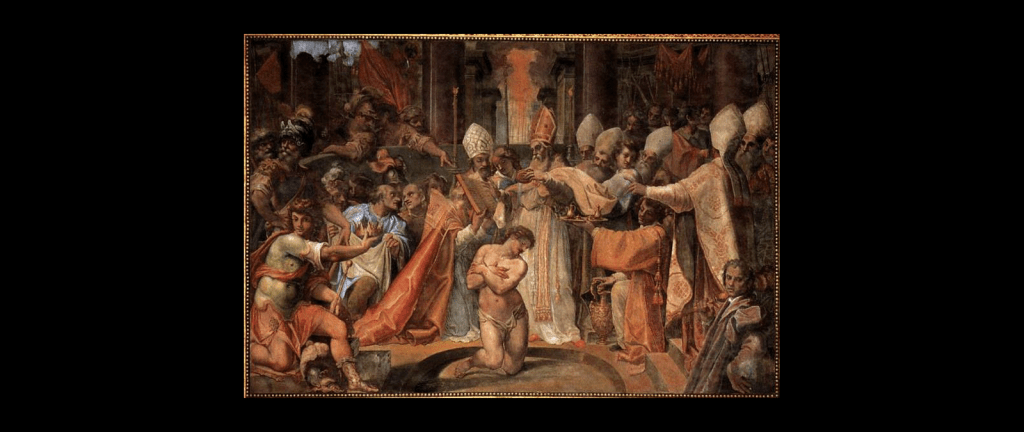
At an early date, tradition brings Sylvester into an intimate relationship with that first emperor of the Christian era, but most of those accounts appear to be apocryphal. Especially important to his memory was the Vita beati Sylvestri, which appeared in the East and has been preserved in Greek, Syriac, and Latin. In that work, there is mention of a supposed Roman council, produced between 501 and 508 AD. Also, the questionable Donation of Constantine (Lat. Donatio Constantini) made Sylvester a pivotal figure in medieval Christianity, as it portrayed him as the recipient of imperial lands and authority, along with his successors in the papacy. The other accounts given in all such writings—concerning the supposed persecution of Sylvester, his healing and baptism of Constantine, the emperor’s gift to the pope, the imperial rights granted to the papacy, and the council of 275 bishops at Rome, not to mention Sylvester’s rescuing Rome from a dragon, though historically doubtful, these elements contributed to his becoming a more memorable papacy.
 Nature and dignity