Feast of the Holy Family ~ December 31
According to A Dictionary of Greek and Roman Antiquities, edited by William Smith, LLD, William Wayte, G. E. Marindin, the linguists examine the word familia: “The Latin word for the house or homestead, which was the principal family possession, is domus; and the combination domus familiaque, for which familia pecuniaque was substituted, designates the family in respect of its familiares or members, and in respect of its dwelling-place with the property attached to it.” The meaning of the word familia, which appears to have originally included only the group of familiares, was extended so as to comprehend all that is subject to the manus or control of a paterfamilias, both free persons, slaves and other objects of property, in this sense corresponding to the Greek οἶκος.
For the first thirteen hundred years of Christianity, though, the compound term Holy Family was used only in reference to Christ’s members rather than to His kin or relatives and friends; that is, the Holy Family was the Church. The same is true of the term sacred family, which has also been used for the household of Jesus, Mary, and Joseph. Another factor affecting devotion to the Holy Family is the need to venerate each member: you have to love Jesus, Mary, and Joseph before you can love them as an earthly trinity, so to speak.
But to some extent, no one can appreciate who Joseph is until they appreciate who Mary is, and you cannot appreciate who Mary is until you appreciate who Jesus is. It took the early Church several centuries and multiple ecumenical councils to clarify the doctrinal understanding of Jesus Christ, which only then enabled the Church to gain a deeper reverence for Mary His Mother. But even with the blossoming of Marian devotion, devotion to Saint Joseph was hindered by an added complication: minimal biblical information and lukewarm endorsements. Apocryphal literature portrayed the foster-father of Jesus as aged, ineffective, and unremarkable in his doubts about Mary his betrothed. Joseph was still honored as a saint, but, as can be illustrated by some medieval mystery plays, he was thought of more as a decent Everyman than a heroically virtuous patriarch.
It was the theologian Jean Charlier de Gerson (1363-1429), chancellor of the University of Paris, who liberated Saint Joseph from his apocryphal doldrums. Gerson taught that the divinely-appointed guardian of Jesus and Mary was young, vigorous, and free from even venial sin because, like the prophet Jeremiah and Saint John the Baptist, he was sanctified in the womb. Gerson also promoted devotion to the Holy Family as a remedy for the acute personal and economic crises that families were facing at that time. In this endeavor, the chancellor was joined by Saint Bernadine of Siena (1380-1444), who was probably the first individual to use the term “Holy Family” for the union of Jesus, Mary, and Joseph.
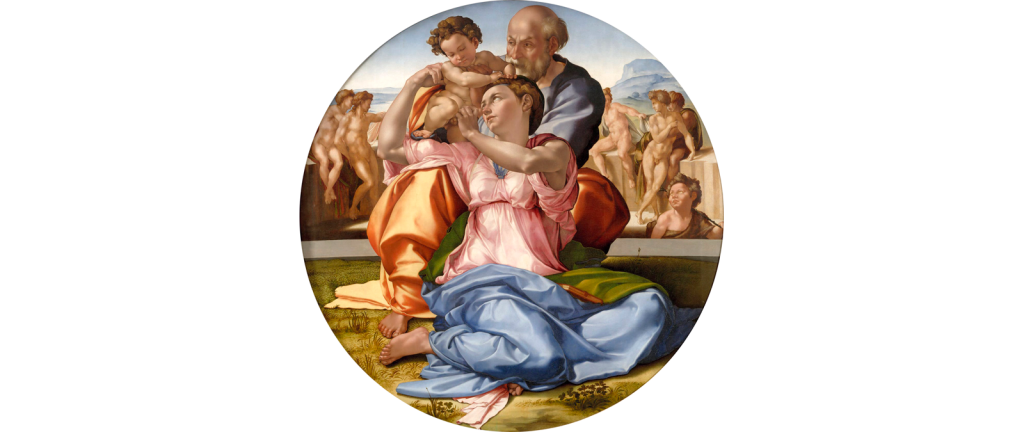
Devotion to the Holy Family of Nazareth became popular in Catholic countries, especially after the Counter-reformation. It may be that by seeing Jesus, Mary, and Joseph as a terrestrial trinity, such a notion safeguarded the doctrine of the perpetual virginity of the Mother of God from disbelievers who contended that Jesus had siblings. It is also the case that devotion to the Holy Family was seen as an aid to Christian families. In fact, the devotion spread quickly in the New World, for example. The French school of spirituality, the principal devotional influence within the Church from the mid-17th century to the mid-20th century, gave the devotion its particular characteristics: (1) the focus on the family as a doorway to the interior life, (2) an entering into the details of the Holy Family through the use of the imagination, (3) a respect for the Jewish traditions that the Holy Family faithfully kept, and (4) a veneration of each member of the Holy Family as a teacher of virtues.
Prayer to the Holy Family
O Holy Family, bless and protect all the families of the world;
safeguard their unity, fidelity, integrity and dignity. Enable them to
live according to God’s law that they may fulfill their sublime vocation.
May their lives be a reflection of yours and may they enjoy your presence
forever in heaven. Amen.
Excerpted from Michael P. Foley. The Feast of the Holy Family. New Liturgical Movement. 7 January 2022
 Nature and dignity