4th Sunday of Advent
St. Athanasius articulated the doctrine of the Incarnation most clearly and persuasively in a treatise known as De Incarnatione Verbi Dei or The Incarnation of the Word of God. He wrote, “But to treat this subject it is necessary to recall what has been previously said; in order that you may neither fail to know the cause of the bodily appearing of the Word of the Father, so high and so great, nor think it a consequence of His own nature that the Savior has worn a body; but that being incorporeal by nature, and Word from the beginning, He has yet of the loving-kindness and goodness of His own Father been manifested to us in a human body for our salvation.”
Athanasius explains that to understand the Incarnation (or Christmas), you have to first be aware of the history of salvation, from its biblical beginning. The reason is that while the Word of the Father appeared bodily, the Word, like God the Father, is incorporeal by nature or immaterial. This is revealed in the first line of the Bible, “In the beginning…God created the heavens and the earth” (Gen 1:1) meaning God created all material existence, though God is spirit. Hence, before the act of creation nothing material existed. Equally true is that those created elements are not eternal and, so, neither is nature nor any particular natural beings.
Such contingent realities were not “from the beginning” in the same way that the Word was from the beginning or from eternity. The true meaning of Christmas, then, is that the eternal, immaterial God became material in the world of His own making. And the immaterial eternal God, in the Word-made-flesh, took on the same material form that we possess—the Word assumed a human body with a human soul. In understanding Christmas as the Feast of the Incarnation, we celebrate Almighty God’s decision to become a man by assuming flesh or a human body.
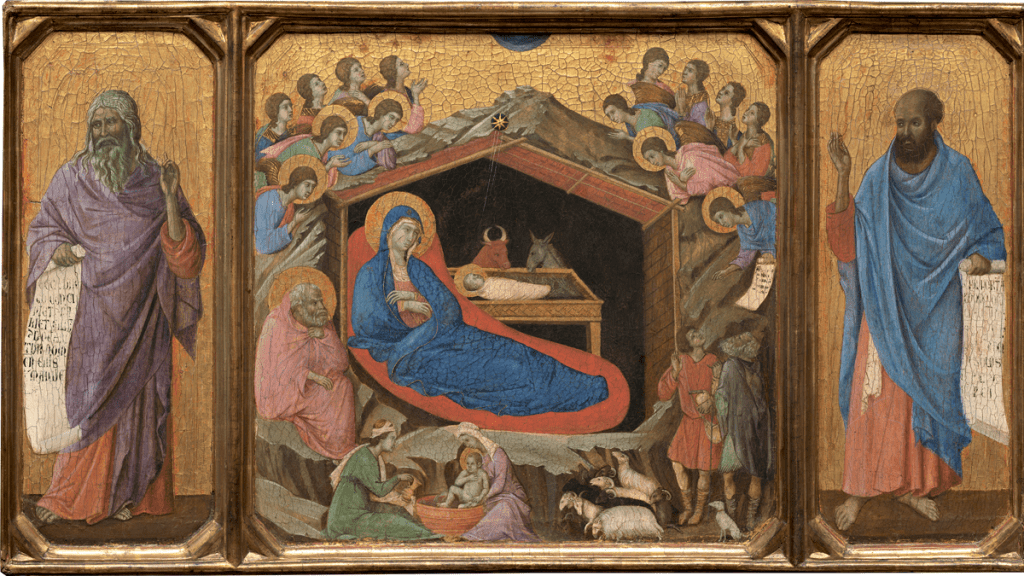
The Heavenly Father, through the angel Gabriel, announced to Mary that she was chosen to be the Mother of God’s only Begotten Son. For her unique role, Mary had been immaculately conceived in the womb of her mother Ann and was made ready from the first moment of her conception for this supreme moment in the history of the world’s salvation. Mary humbly accepted the Divine invitation and submitted to the will of her Heavenly Father in all things. When her time came, she gave birth to an infant Child and named Him Jesus. Being truly human, “…Jesus advanced [in] wisdom and age and favor before God and man” (Lk 2:52).
This Divine Mystery of the Incarnation remains beyond our ability to comprehend fully but we are all privy to the facts that surround the Mystery. It is important to know that the human and divine natures of Jesus are not mixed; one does not dissolve into the other. We accept this on faith. Jesus is one Divine Person with two natures. The human and divine natures in Jesus Christ coexist without becoming commingled. His humanity is always fully present, while His divinity is veiled. And yet, Jesus is one Divine Person, God incarnate, the Word-made-flesh.
Saint Augustine was amazed at the two generations of Jesus Christ, how scripture reveals Christ as the eternal Son always in the state of being generated from the Father. He is the radiance of the Father’s Glory. He also was amazed at the miracle of the virgin birth. In one of his sermons, the Bishop of Hippo makes a series of contrasts between those two births, “Christ as God was born of His Father, as man of His Mother, of the immortality of His Father, of the virginity of His Mother; of His Father without a mother, of His Mother without a father; of His Father without time, of His Mother without seed; of His Father as the source of life, of His mother as the end of death; of His Father, ordering every day, of His Mother, consecrating this particular day” (St. Augustine, Sermo 194, cap.1, no.1; PL 38:1015).
 Nature and dignity