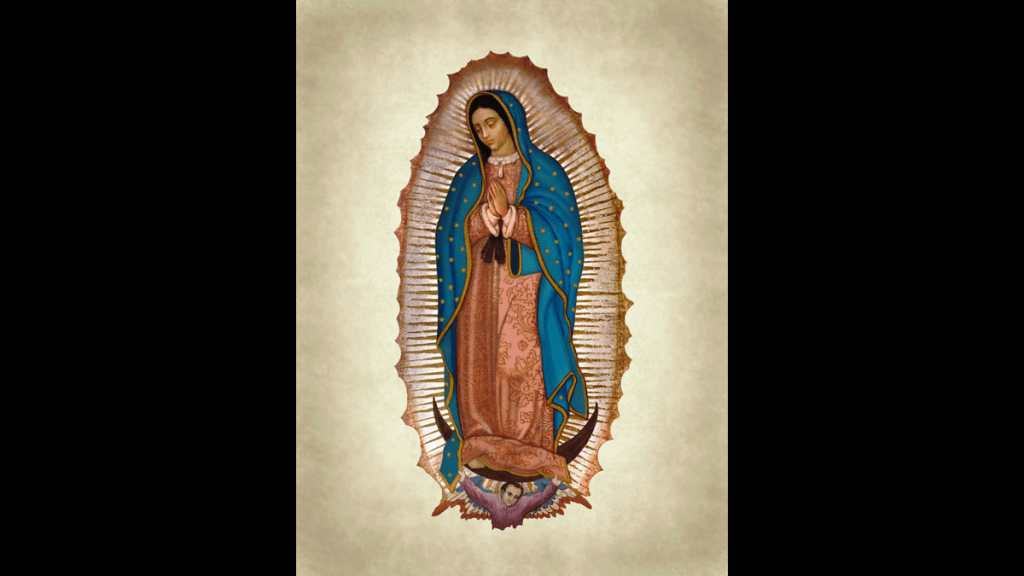
The Shrine of Our Lady of Guadalupe, in Mexico City, is one of the premier pilgrimage sites in the Americas—in 2021, an estimated 1.5 million pilgrims gathered there on her feast day. Throughout the Americas, many other observances of the Virgin’s feast day will take place on December 12. Her feast, on that day, commemorates Mary’s December 9–12, 1531 appearances to Saint Juan Diego, the Náhuatl-Aztec who had recently converted to Catholicism, whose own tilma or cloak bore—and continues to bear—the miraculous imprint of her image from when “the desert rejoiced and blossomed” (Is 35:1) at Mt. Tepeyac with Castilian roses blooming in December: the image of the La Morenita, the indigenous mestiza clothed with the sun and wearing the cinta, the band of pregnancy, standing on the moon, head bowed and hands folded in prayer, and born aloft by an angel of the Lord.
The Virgin of Guadalupe belongs in a particular way to Advent because, like Mary herself in the Magnificat, she proclaims to us the glad tidings of our salvation in Christ and that God scatters the proud, exalts the lowly, fills the hungry with good things, and remembers his promises to Abraham and his children forever. In the Directory on Popular Piety and the Liturgy (DPPL), the Marian tone to the month of December is described in the following manner, “The feast of the Immaculate Conception…the feast of the pure and sinless Conception of the Virgin Mary…is a fundamental preparation for the Lord’s coming into the world, harmonizes perfectly with many of the salient features of Advent. This feast also makes reference to the long messianic waiting for the Savior’s birth and recalls events and prophecies from the Old Testament, which are also used in the Liturgy of Advent. The approach of Christmas is celebrated throughout the American continent with many displays of popular piety, centered on the feast of Our Lady of Guadalupe (12 December), which dispose the faithful to receive the Savior at his birth. Mary, who was ‘intimately united with the birth of the Church in America, became the radiant Star illuminating the proclamation of Christ the Savior to the sons of these nations'” (DPPL, n. 102).
Mary herself is the means by which the Incarnation takes place. Understood that way, you can describe the Virgin Mary as Advent personified. God the Father had prepared her from the first moment of her life to be the worthy Mother of His Son. Like a faithful daughter of Israel, she had prayed throughout her youth for the coming of the Messiah. When Mary was a young girl, she discovered that she was part of God’s answer to those prayers, but in a way that would far exceed any Hebrew maiden’s prayers: not only would the Messiah be her son, but her son would also be God. Her “yes!” to the Archangel Gabriel launched the proximate preparation for the birth of Jesus the Messiah.
Saint Bonaventure, in writing about Francis of Assisi and il Poverello’s devotion to Mary said, “[Francis] embraced the Mother of our Lord Jesus with indescribable love because, as he said, it was she who made the Lord of majesty our brother, and through her we found mercy. After Christ, he put all his trust in her and took her as his patroness for himself and his friars” (Bonaventure. Major Life. Ch. IX). In a conference he gave in 1936, the Polish martyr Saint Maximilian Kolbe said, “Our life, must be an extension on this earth of Jesus’ life by means of Mary.”
Pray for us, O holy Mother of God, that we may be made worthy of the promises of Christ.
 Nature and dignity