

Sunday Gospel ~ Matthew 25:31-46
While this Sunday’s Gospel is commonly labeled as the parable of the sheep and the goats, in fact, it is not a parable nor is it really about sheep and goats. This end-of-the liturgical year passage comes as the conclusion to a chapter-long description of the end times—beliefs concerning the final events of history or the destiny of humanity. This extensive description began when the disciples asked Jesus this question, “Tell us, when this will happen, and what sign will there be of your coming, and of the end of the age?” (Mt 24:3). The Gospel comprises three various three groups: (1) the sheep who are placed on the right of the king or the Son of Man; (2) the goats who are placed on the left; and (3) the least brothers of mine, who are the hungry, thirsty, strangers, naked, sick and imprisoned.
The central feature of the whole narrative is Jesus Himself, described in the most exalted terms, as the Son of Man, the Lord’s favorite self-description in the Gospels and a term primarily taken from Daniel 7.13, where it refers to the vulnerable corporate figure of Israel, exalted to God in the face of the trampling beasts of the earlier part of the vision. This personification of faithful Israel, according to Daniel’s vision, “comes with the clouds of heaven” to the throne of the Ancient of Days, and is given an everlasting kingdom. It is therefore not so surprising that in Matt 25.31 the Son of Man “sits on the throne of his glory” and thereafter is referred to in royal terms as king as he exercises judgment. The attendance of “his angels with him” is an allusion to Zechariah 14.5, there the “holy ones” accompany Yahweh, “my God.” Lastly, this Son of Man/king/judge also takes the role of shepherd; in Ezekiel 34, while the leaders are supposed to shepherd God’s people, the chief shepherd is God Himself and Him alone. Jesus is making some truly astonishing claims here. The main thrust of this passage, since it is the climax of the discourse on judgment, is its portrayal of the ultimate sovereignty of the Son of Man as the universal judge of all.
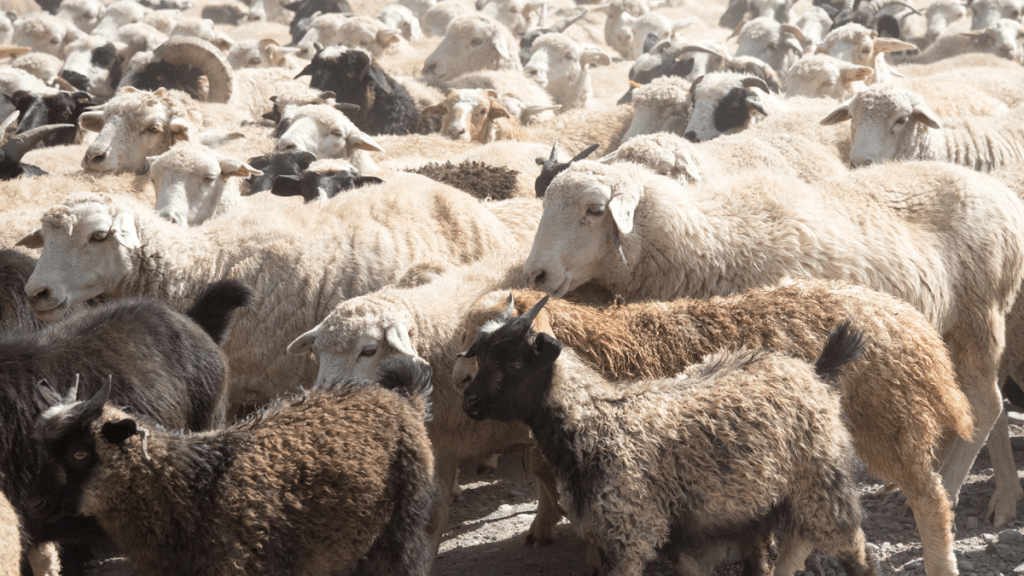
When you look at Matthew 25, you see that the word translated ‘goat’ is actually the word eriphos (Gk. ἔριφος), the male term for a kid he-goat—also used ironically by the elder brother in Luke 15:29 (“you never gave me a goat kid” or kid). So Jesus’ reference to the separation appears to be drawing on a well-known and regular occurrence in herding—the separation out and culling off of the young male goats as something that the herdsmen would do as a natural part of their work. In other words, the focus of the action is not on the different types of animals, but on the process of separation.
This is supported when we read on in the parable; beyond Matthew 25:32–33, the two groups are not again referred to as sheep and goats, but as those on the king’s right and those on his left, thus, not only affecting the shape of the narrative, but also its emotive effect. The king invites those on his right to “Come, you who are blessed by my Father. Inherit the kingdom prepared for you from the foundation of the world…” Those addressed respond with complete surprise, and the king has to explain that “…whatever you did for one of the least brothers of mine, you did for me.” Likewise, those on his left are also surprised to have encountered the king in his moment of need. If the narrative were about helping the poor, then those who helped the poor would hardly be surprised to find that they had been doing what the king had asked them to do.
And the language here challenges the notion that entrance into the kingdom is a reward that has been merited by a life of good works. Rather, the language of inheritance echoes God’s promise to Israel, for whom the land is an inheritance, granted to them not because of their virtue, but because they are God’s son, and they inherit as a son inherits from a father in the ancient world. In order to inherit, you do not need to be good, you just need to be a son, and this image of adoption by God and, so, receiving the inheritance because of God’s gracious generosity is found all over the New Testament. The least brothers of mine is not a reference to being generous to the poor in general, but refers to those who belong to the cadre of Jesus’ own followers. Those on the king’s right are people who have welcomed his poor followers, and in so doing have welcomed Jesus. Thus, the dividing line is not between those who care for the poor or who do not, but it demarcates those who receive and care for the followers of Jesus or those who do not. By doing so, such generosity reveals their attitude to the King Himself.
Excerpted from Ian Paul. The ‘Parable’ of the Sheep and the Goats in Matthew 25. Psephizo, 18 November 2020.
 Nature and dignity