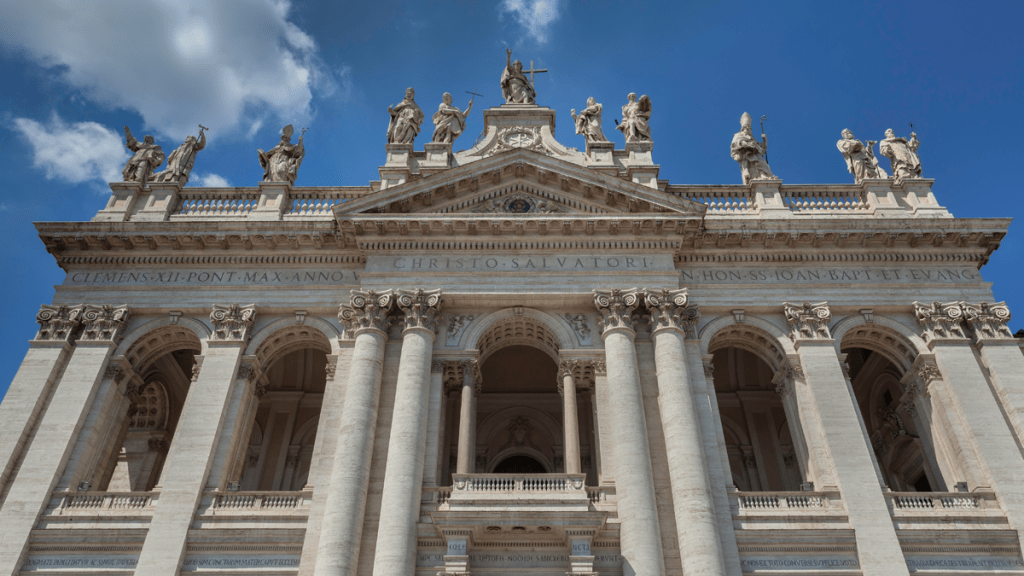
The dedication of any church or chapel is a spiritual feast for all its parishioners or for those who worship there. Yet, in a certain sense, as the parish church of all Catholics because it is the Pope’s cathedral, Saint John Lateran is the spiritual home of the people who are the Church. Briefly known as the Lateran Basilica, it was originally dedicated to Christ the Savior and, centuries later, it was co-dedicated to Saint John the Baptist and Saint John the Evangelist. Saint John Lateran is considered the mother church of the Roman Catholic faithful, which is attested to by this Latin inscription on its façade, omnium ecclesiarum Urbis et Orbis mater et caput (Eng. mother and head of all the churches in the city and the world).
Imagine that the date is 573 B.C. The Israelites are living in exile. Their nation has been trampled, the holy City of David was defiled, and their people deported into slavery in Babylon. It has been fourteen sorrowful years since King Solomon’s temple in Jerusalem was completely destroyed in 586 BC. Imagine, if you can, the distress those exiled must have felt. However, now imagine their reaction as God sends the prophet Ezekiel with a message of hope. Ezekiel is the first prophet who received his calling (vocation) during the Babylonian exile (597-538 B.C.). Many people are aware of the most important Babylonian deportation that happened during the years just prior to 587-586 B.C., i.e., the classical date for the destruction of Jerusalem. Before that tragic event, the Babylonians initiated the first deportation around the years 598-597 B.C. While initially somber in tone, eventually, Ezekiel’s prophecies turned more hope-filled. Though the temple was destroyed, he prophesied that a new temple would emerge, better than the old. From this temple water would flow water that would bring life and healing. Through that prophet, God tells His disheartened people not to dwell on their present circumstances but to look to God of Israel and trust in His promises.
History testifies that God’s vision for the temple was ultimately fulfilled in Jesus Christ. The Lord’s own body was the temple that was destroyed but raised up again by the power of God (Jn 2:19). Now, as members of Christ’s body, the Church, all of us are part of this holy temple. Jesus is the source of the river from which flows abundant life, power, and grace. Baptized into Christ’s death, the newly-baptized are immersed in God’s river of life. Thus, we ourselves are meant to become channels of grace. Baptized into Christ’s death, we are immersed in God’s life-giving river of eternal life. We ourselves are meant to become channels of grace and healing. As the Church, then, we are called to bring life to the world.
This is what the universal Church celebrates on November 9th as the liturgical calendar turns our attention to the Basilica of St. John Lateran in Rome. Described as the “mother and head” of all the churches, this papal cathedral was built soon after 312 AD, the year in which the Roman emperor Constantine gave all his Christian subjects the freedom to pursue their faith without persecution. The basilica takes its name from John the Baptist and John the Apostle, and also from the Laterani, the family of Constantine’s wife, who donated the land on which the church still stands. Saint John Lateran is not just an ancient historical site. This feast, honoring the cathedral of the Diocese of Rome, is a symbol of the living Church – dynamic, vibrant, gushing with the living water of divine life and love. Take a drink! Plunge in! Swim out into the deep, transforming waters of God’s love and grace, and you will see the Church and the world renewed. On that festive day, let us tell the Lord that we are plunging into His river of life, right into the deep end. We ask Him to let us receive all that He has for us so that we can be a channel of His life and mercy to the world.
 Nature and dignity