

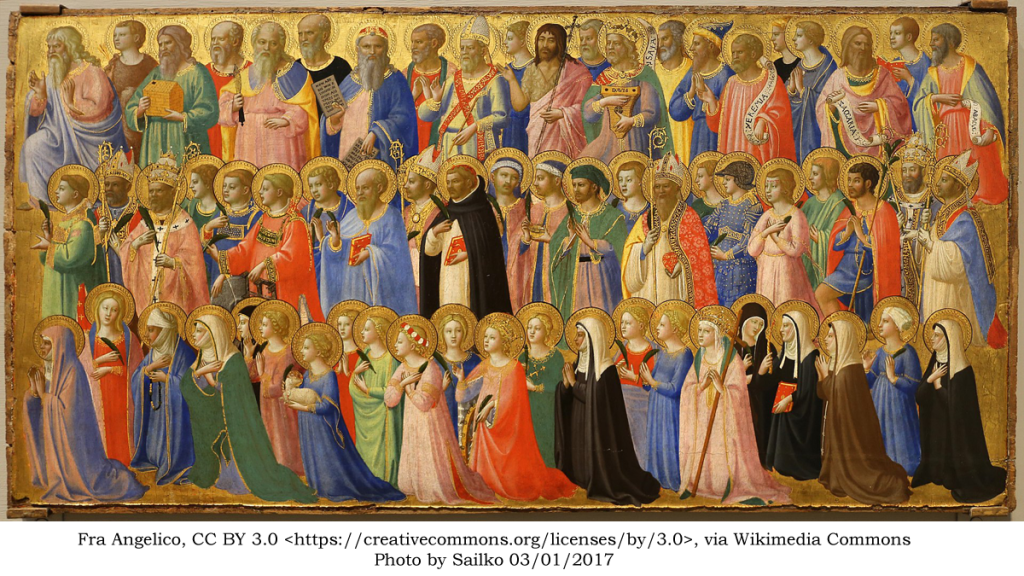
Communion of Saints – Communio sanctorum – agiōn koinōnian
The term “Communion of Saints” comes from one of the articles of the Apostles’ Creed that, in Latin, reads this ways: Credo in … sanctorum communionem, whereas in Greek transliterated into the Roman alphabet, the communion of saints is labeled as agiōn koinōnian.
The first Greek word agiōn, usually translated as “saints,” is the word used widely by some Christians to simply refer to other members of the faithful and not only a reference to canonized saints. It does not only refer to those who have had more exemplary lives than others. The term “holy” just means those on whom the Holy Spirit has been outpoured through the gift of baptism.
The second term, koinōnian, is most commonly translated as communion or fellowship. Wherever koinonia appears, it describes the relationship of those who know each other, whether it refers to other humans or to God (Father, Son, Spirit). It points the depth of a relationship between those who are living a common life together, in varied ways. Koinonia is never used in an abstract way in early Greek Patristic writings. It is always about meaningful, real relationships with others.
In English, the Latin expression is rendered as “I believe in … the communion of saints.” The entire section of the Creed in which that expression can be found is this, “I believe in the Holy Spirit, the holy catholic church, the communion of saints, the forgiveness of sins, the resurrection of the body, and life everlasting.” Etymologically, the Latin term communio sanctorum can mean either “communion ‘in holy things (sanctus)’ and ‘among holy persons (sancti)’” (CCC, n. 948), which represents the twofold meaning of communio sanctorum —sharing in holy things (sancta) and among holy persons (sancti) as complementary.
In writings from the Eastern Churches, the communion of saints is more literally described as “the koinonia of the holy.” Koinonia is a transliterated form of the Greek word κοινωνία, which refers to concepts such as communion or fellowship, joint participation, partnership, the share which one has in anything, a gift jointly contributed, a collection, a contribution and so forth.
One of the most underappreciated teachings of the Church is her understanding of the communion of saints. Just as the Church is called to be “holy” or “set apart,” so too, the saints are “holy ones,” those set apart from the world. Baptism inserts us into the communion of the Church and thereby places the call upon all of us to become saints. This communion, though, does not simply hold to those of us who are here on earth. In addition, the communion extends to those who are the Church suffering in purgatory, as well as those who are in the Church triumphant or in heaven. The communion of saints, then, is made of all Christians who are members of the one body of Christ. This implies that the as the Church here on earth, we are also called to be in communion with one another. This communion is guaranteed and strengthened by our reception of Holy Communion where Jesus gives us His body to become more fully His body the Church. Thus, when we sin seriously, when we do not hold on to what Christ has given us in faith, we refrain from receiving Communion because we are saying: through my actions and beliefs, I am not in communion with Christ and his Church.
 Nature and dignity