

30th Sunday Year A ~ Matthew 22:34-40
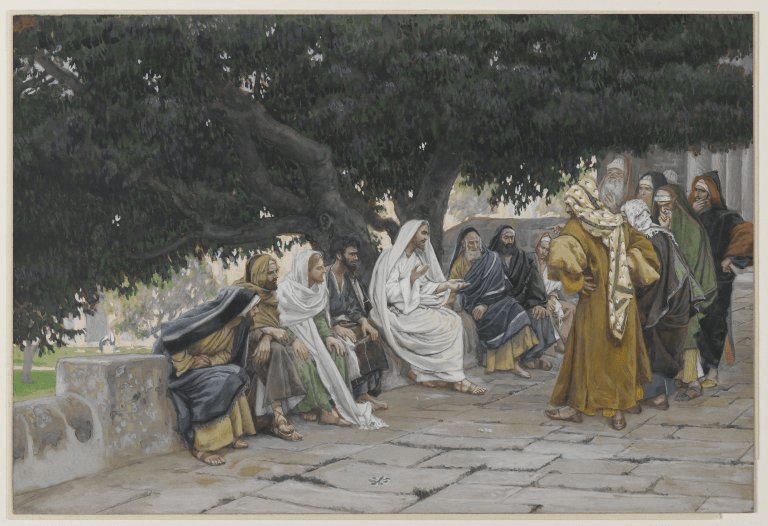
The Sunday Gospels for the month of October, whether expressed in parables or debates, Jesus has engaged in theological discussions with the three principal religious/political parties of His time: The Pharisees and Herodians over paying taxes to Caesar (Mt 22:15-22) or the Sadducees in regard to the resurrection of the dead (Mt 22:23-33). Then, in this weekend’s Gospel, it was declared, “When the Pharisees heard that Jesus had silenced the Sadducees…one of them, a scholar of the law, tested (Gk. πειράζων) him by asking, ‘Teacher, which command in the law is the greatest?’” The Greek word peirazōn or “tested” has both a negative and a positive sense: literally, the word means to make proof of or to test, yet it can also mean to tempt. So, the question that was posed to Jesus did not indicate an honest discussion between Him and that solitary interlocutor or scribe. Instead, that verb’s implication reveals that this exchange was part of a collective endeavor that attempted to expose what Jesus thought about the matter at hand or how He would behave when faced with their entrapment.
Remember, in Judaism, what Christians identify as the Old Testament is composed of three parts: (1) the Torah or the Law which comprises the first five books of the Bible; (2) the Nevi’im or the prophets; and (3) the Ketuvim or the Writings. In Jewish thought, the Torah is the Bible’s most sacred part and what subsequently the prophets said or what are now described as the Writings, those portions are measured against the Torah, which is often used to separate true from false prophets.
The Torah or Law consists in 613 commandments. In their commitment to follow God’s will, the Pharisees understood that it was required to live by those 613 commandments. In wanting to properly and minutely fulfill such an extensive set of positive and negative commands, over the centuries, it resulted in multiple layers of interpretation. Generally, the Torah can be interpreted in several different ways: (1) a simple or literal sense; (2) by analyzing the hints and allusions it contains; (3) midrash or examining the deeper meaning of the verse; (4) or the Torah’s esoteric or mystical meaning. So, the scholar of the law or scribe raises a question which, no doubt, had been debated among the Pharisees themselves: how do you rank or prioritize these commandments?
In His reply, Jesus simplifies the matter of legal complexity and refocuses those over-hearing His exchange with that scribe and He goes to the core of Jewish belief, the profession of faith that every observant Jew recites frequently or the Šəmaʿ Yīsrāʾēl that is vocalized as Shema yisra’el: “Hear, O Israel, the Lord is our God. You shall love the Lord your God with your whole heart and mind and strength” (Dt 6:4-9). To that foundational prayer, Jesus adds the second commandment concerning love of neighbor by citing the Book of Leviticus (Lev 19:18). Thus, all those hundreds of Levitical laws can legitimately be observed by doing two things: in loving God and our neighbor as ourselves.
 Nature and dignity